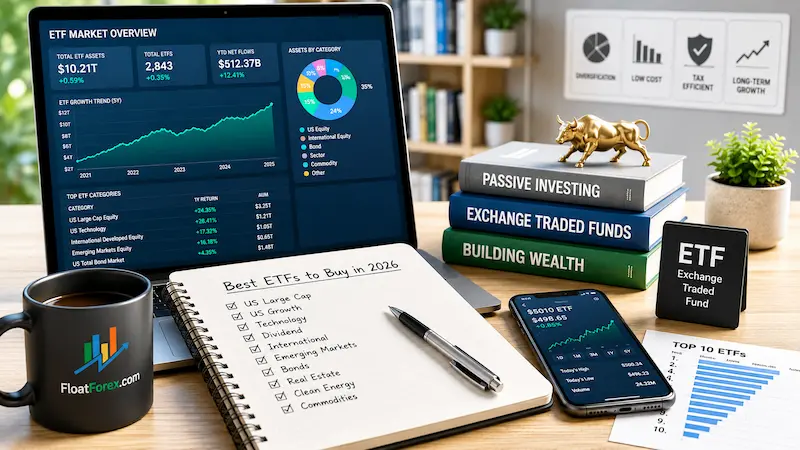

The Best ETFs to Buy in 2026 — The Direct Answer
The best ETFs to buy in 2026 depend on the job you need each fund to do, but a handful of low-cost, highly liquid funds dominate every category. For core US exposure, the Vanguard S&P 500 ETF (VOO) leads on cost and scale. For growth, the Invesco QQQ Trust (QQQ) captures big tech. For income, the Schwab U.S. Dividend Equity ETF (SCHD) stands out. For bonds, the Vanguard Total Bond Market ETF (BND) is the default, and for international diversification, the Vanguard Total International Stock ETF (VXUS) covers the rest of the world. Below we break down the top 10 ETFs across 10 categories, with current fees, yields and assets so you can match the right fund to your goal.
If you are new to exchange-traded funds entirely, start with our foundational guide What Is an ETF and How Do You Invest in One? before choosing specific tickers.
How We Picked the Best ETFs for 2026
Thousands of ETFs exist, so we filtered for the traits that research consistently links to long-term success rather than short-term hype:
- Low expense ratio — fees are the single most reliable predictor of net returns over time. The industry average is around 0.44%; the funds below mostly charge a fraction of that.
- Large assets under management (AUM) — bigger funds tend to be more durable and less likely to close.
- Tight bid-ask spreads — high liquidity means you trade efficiently without losing money on the spread.
- Clear, repeatable strategy — each fund does one job well, making it easy to build a portfolio.
The Top 10 ETFs by Category — Quick Comparison
Here is the full lineup at a glance. Figures are approximate and drawn from 2026 fund and market data; expense ratios and yields change over time, so always confirm on the provider's site before buying.
| # | Category | Top ETF | Ticker | Expense Ratio | Approx. Yield |
|---|---|---|---|---|---|
| 1 | Core US (S&P 500) | Vanguard S&P 500 ETF | VOO | 0.03% | ~1.1% |
| 2 | Total US market | Vanguard Total Stock Market ETF | VTI | 0.03% | ~1.2% |
| 3 | Growth / Tech | Invesco QQQ Trust | QQQ | 0.20% | ~0.4% |
| 4 | Dividend / Income | Schwab U.S. Dividend Equity ETF | SCHD | 0.06% | ~3.7% |
| 5 | Bonds (core) | Vanguard Total Bond Market ETF | BND | 0.03% | ~4.3% |
| 6 | International | Vanguard Total International Stock ETF | VXUS | 0.05% | ~3.0% |
| 7 | Global all-in-one | Vanguard Total World Stock ETF | VT | 0.06% | ~1.9% |
| 8 | Gold / Commodity | SPDR Gold MiniShares | GLDM | 0.10% | 0% |
| 9 | Bitcoin / Crypto | iShares Bitcoin Trust | IBIT | 0.25% | 0% |
| 10 | Low-volatility / Defensive | iShares MSCI USA Min Vol Factor ETF | USMV | 0.15% | ~1.7% |
1. Best Core US ETF — Vanguard S&P 500 ETF (VOO)
VOO is the cornerstone holding for most portfolios. It tracks the S&P 500 — 500 of the largest, most established US companies — at an ultra-low 0.03% expense ratio, meaning just $3 a year per $10,000 invested. It is also the largest US-listed ETF by assets, with hundreds of billions under management. Historically the S&P 500 has returned roughly 10% annually with dividends reinvested over the long run, making VOO the default "set and forget" choice.
Best for: Almost everyone. If you buy only one ETF, a broad S&P 500 fund like VOO is the most common recommendation among long-term investors.
2. Best Total-Market ETF — Vanguard Total Stock Market ETF (VTI)
VTI takes VOO one step further, holding over 3,500 US stocks across large-, mid- and small-cap companies for the same 0.03% fee. You get the entire US stock market in a single fund. The difference versus VOO is small in practice — the S&P 500 makes up most of the US market by value — but VTI captures smaller companies that VOO leaves out.
Best for: Investors who want maximum US diversification in one ticker.
3. Best Growth ETF — Invesco QQQ Trust (QQQ)
QQQ tracks the Nasdaq-100, concentrating in the largest non-financial companies — heavily weighted toward technology names like Nvidia, Apple, Microsoft, Broadcom and Amazon. Over the past decade QQQ has delivered exceptional total returns, far outpacing the S&P 500, driven by the tech and AI boom. The trade-off is higher volatility and a steeper 0.20% fee. A lower-cost sibling, QQQM, tracks the same index for less.
Best for: Investors bullish on technology and willing to accept bigger swings for higher growth potential.
4. Best Dividend ETF — Schwab U.S. Dividend Equity ETF (SCHD)
SCHD screens for around 100 high-quality, consistent dividend payers, delivering a trailing yield near 3.7% — far above the S&P 500's ~1.2% — at a low 0.06% fee. The regular income helps newer investors stay invested through volatility. Think of it as a quality-income satellite alongside a broad core holding, not a replacement for VOO or VTI.
Best for: Income-focused investors and those who want a value tilt. Dividend reinvestment pairs naturally with dollar-cost averaging.
5. Best Bond ETF — Vanguard Total Bond Market ETF (BND)
BND is the default bond allocation for most portfolios. It holds the entire US investment-grade bond market — Treasuries, corporate bonds and mortgage-backed securities, over 11,000 holdings — at a 0.03% expense ratio, with a 30-day SEC yield around 4.2-4.5%. With interest rates still elevated in 2026, bond yields are meaningfully higher than they were in the 2010s. When advisors say "put X% in bonds," they usually mean a fund like BND.
Best for: Adding stability and income to any diversified portfolio.
6. Best International ETF — Vanguard Total International Stock ETF (VXUS)
VXUS gives you the entire stock market outside the US — developed and emerging markets — in one fund at just 0.05%. It is roughly a 3:1 split of developed to emerging markets. Pairing VTI (US) with VXUS (international) creates a complete global stock portfolio for around 0.04% in blended fees, with international exposure that can outperform when the US lags.
Best for: Diversifying beyond US borders and reducing single-country risk.
7. Best All-in-One Global ETF — Vanguard Total World Stock ETF (VT)
VT is the ultimate hands-off fund: a single ticker holding around 10,000 stocks spanning the US, developed international and emerging markets across all sectors, for about 0.06%. There is nothing to rebalance — VT automatically tracks the global market's weighting. Combine it with a global bond fund and you have a complete portfolio in two holdings.
Best for: Truly passive investors who want one fund and no maintenance.
8. Best Gold ETF — SPDR Gold MiniShares (GLDM)
For commodity and inflation diversification, a physically-backed gold ETF lets you own gold exposure without storing bullion. GLDM offers this at a low 0.10% fee, cheaper than the better-known GLD. Gold often moves independently of stocks and can act as a hedge in turbulent markets. To understand what actually drives the metal's price, see our guide on What Moves Gold Prices.
Best for: Diversification and as a potential inflation hedge — explored further in How to Protect Your Money From Inflation.
9. Best Bitcoin ETF — iShares Bitcoin Trust (IBIT)
Spot Bitcoin ETFs let you gain Bitcoin exposure inside a regular brokerage account, without managing a crypto wallet or private keys. IBIT is among the largest by assets. The trade-off versus owning Bitcoin directly is that you cannot move or spend the coins, and the ETF only trades during market hours. ETF flows now heavily influence Bitcoin's price, as seen in the large outflows of mid-2026. For the direct-ownership alternative, read What Is Bitcoin and How Does It Work?
Best for: Investors who want crypto exposure with the simplicity and tax treatment of a brokerage product.
10. Best Defensive ETF — iShares MSCI USA Min Vol Factor ETF (USMV)
When markets get choppy, a low-volatility fund can soften the ride. USMV builds a portfolio of US stocks selected to minimize overall volatility, tending to hold steadier, defensive names. It typically falls less in downturns than the broad market — useful if recession risk is on your radar.
Best for: Conservative investors or anyone worried about a downturn — see Is a Recession Coming? for the warning signs.
Index Funds vs ETFs — What's the Difference?
Many of the funds above are technically index ETFs, and the terms overlap. The key distinctions:
| Feature | ETF | Traditional Index Fund |
|---|---|---|
| How it trades | Like a stock, all day | Once per day at closing price |
| Minimum investment | Price of one share (or fractional) | Often a set dollar minimum |
| Tax efficiency | Usually higher | Slightly lower in taxable accounts |
| Best for | Flexibility, fractional buying | Automatic recurring investing |
How to Build a Simple ETF Portfolio in 2026
You do not need all 10 funds. Most investors do well with a handful:
- The one-fund portfolio: VT (or VTI) — global or US stocks in a single holding.
- The two-fund portfolio: VTI + VXUS — US plus international stocks.
- The three-fund portfolio: VTI + VXUS + BND — stocks, international, and bonds. A classic, durable mix.
- Add a tilt: layer in SCHD for income, QQQ for growth, or GLDM for diversification, as a smaller satellite position.
Whatever you choose, investing consistently over time tends to beat trying to time the market — the core idea behind dollar-cost averaging.
Frequently Asked Questions
What is the single best ETF to buy in 2026?
There is no universal "best," but a low-cost S&P 500 fund like VOO is the most common recommendation for a core holding because of its low 0.03% fee, broad diversification, and long track record. The right pick depends on your goal, timeline and risk tolerance.
How much money do I need to start investing in ETFs?
Often very little. Many brokerages now offer fractional shares, letting you start with as little as $1. Otherwise you need the price of one share, which varies by fund.
Are ETFs safe for beginners?
ETFs spread your money across many assets, which reduces (but does not eliminate) risk compared with owning individual stocks. Broad, low-cost index ETFs are widely considered among the most beginner-friendly investments, though all investing carries risk of loss.
What does the expense ratio mean and why does it matter?
The expense ratio is the annual fee charged as a percentage of your investment. A 0.03% ratio costs $3 per $10,000 each year. It is deducted gradually and compounds over time, so lower-cost funds tend to outperform similar higher-cost ones over the long run.
Should I buy growth ETFs like QQQ or stick to the S&P 500?
QQQ has historically outperformed the S&P 500 thanks to its tech concentration, but it is more volatile and can fall harder in downturns. Many investors hold a broad core like VOO and add QQQ as a smaller growth tilt rather than choosing one or the other.
How are ETF dividends taxed?
In a taxable account, ETF dividends are generally taxed in the year you receive them, with qualified dividends often taxed at lower rates. Holding ETFs in a tax-advantaged retirement account can defer or reduce that tax. Rules vary by country, so confirm your local treatment.
Can I lose money in an ETF?
Yes. ETFs rise and fall with their underlying assets. Diversification lowers risk but does not remove it, and there is never a guarantee you will get back what you paid.
The Bottom Line
The best ETFs to buy in 2026 are low-cost, liquid, and built for a clear purpose: VOO or VTI for your US core, QQQ for growth, SCHD for income, BND for stability, VXUS for international reach, and specialty funds like GLDM, IBIT or USMV as smaller satellite positions. Rather than chasing every category, pick a simple two- or three-fund framework, keep fees low, and invest consistently. The unglamorous combination of broad diversification, rock-bottom costs, and patience is what compounds into real wealth over decades.
The best ETF portfolio is usually a boring one — low-cost, broadly diversified, and held for the long term. Time in the market beats timing the market.
Related FloatForex Guides & Tools
- What Is an ETF and How Do You Invest in One?
- Dollar-Cost Averaging Explained
- How to Protect Your Money From Inflation
- What Moves Gold Prices?
- What Is Bitcoin and How Does It Work?
- Is a Recession Coming?
Disclaimer: This article is for educational purposes only and does not constitute financial, investment, or tax advice. ETF prices, yields and expense ratios change over time, and all investing carries risk of loss. Always do your own research and consult a licensed financial professional before making any investment decision.