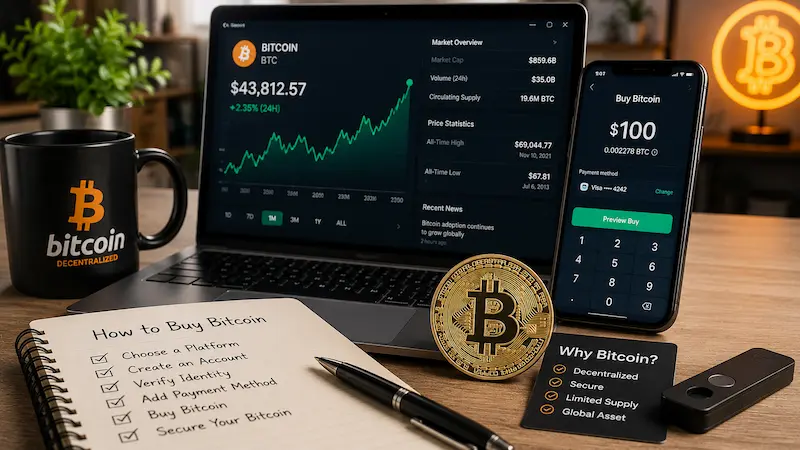

How to Buy Bitcoin in 2026 — The Direct Answer
To buy Bitcoin in 2026, you open an account on a regulated cryptocurrency exchange, verify your identity with a government ID, deposit money from your bank or card, and place a buy order for as little as $1. You can then leave your Bitcoin on the exchange or move it to a private wallet for safer long-term storage. The entire process takes most beginners under 30 minutes, and you do not need to buy a whole Bitcoin — fractions are perfectly normal.
This guide walks you through every step in plain English: choosing the right platform, what fees to expect, how to keep your coins safe, and whether buying Bitcoin directly or through an ETF makes more sense for you. If you are brand new to the asset itself, start with our foundational guide What Is Bitcoin and How Does It Work? before you put any money in.
Step 1 — Choose a Regulated Exchange
An exchange is simply the marketplace where you swap your local currency for Bitcoin. In 2026 the market is more mature and regulated than ever, so the most important filter is trust, not flashy features. Stick to established, licensed platforms with transparent fees, strong security, and proper Know-Your-Customer (KYC) verification. Avoid any app promising "guaranteed returns" or anyone messaging you directly about a deal.
Look for these signals before signing up:
- Regulatory licensing — the platform publishes its licenses and operates legally in your country.
- Cold storage — the majority of customer funds (often 95%+) are kept offline.
- Two-factor authentication (2FA) and ideally hardware-key or biometric login.
- Transparent fees shown before you confirm a purchase.
- Bitcoin withdrawals enabled — so you can move coins to your own wallet later.
Popular beginner-friendly exchanges in 2026 include Coinbase, Kraken, and Gemini for their strong regulatory compliance and clean interfaces, while platforms like Binance and Bitget are known for lower trading fees. Availability and features vary by country and, in the US, sometimes by state — always confirm the platform supports your region.
Step 2 — Verify Your Identity (KYC)
Every legitimate exchange is legally required to verify who you are. You will upload a government-issued ID and usually take a quick selfie. This typically takes 10 to 30 minutes to approve and exists to protect you from fraud and the platform from money laundering. If a service lets you buy large amounts with no verification at all, treat that as a red flag.
Step 3 — Deposit Your Funds
Once verified, you connect a funding source and move money into your exchange account. Your choice here directly affects how much you pay:
| Payment Method | Speed | Typical Cost | Best For |
|---|---|---|---|
| Bank transfer (ACH / SEPA) | 1–3 days | Free or very low | Lowest-cost, larger purchases |
| Debit / credit card | Instant | Higher (often 1–4%) | Speed and convenience |
| Wire transfer | Same / next day | Flat bank fee | Very large deposits |
| Apple Pay / Google Pay | Instant | Moderate | Mobile-first beginners |
For most people, a bank transfer is the cheapest route. Cards are fastest but you pay a premium for the convenience.
Step 4 — Place Your Buy Order
Now for the actual purchase. Exchanges offer two main order types, and understanding the difference saves you money:
| Order Type | How It Works | When to Use It |
|---|---|---|
| Market order | Buys instantly at the current price | You want speed and a small amount |
| Limit order | Only buys when the price hits a level you set | You want price control on a larger buy |
Beginners often start with a small market order to learn the interface. You enter a dollar amount — say $50 — and the exchange shows you exactly how much Bitcoin (e.g. 0.00075 BTC) you will receive before you confirm.
Should you buy all at once?
Bitcoin is highly volatile. In June 2026 alone it slid from around the low-$70,000s toward the mid-$60,000s amid record spot-ETF outflows, a reminder that timing the market is extremely hard. A common beginner strategy is dollar-cost averaging: investing a fixed amount on a regular schedule so a single bad entry day matters less. We cover this approach in detail in Dollar-Cost Averaging Explained.
Step 5 — Secure Your Bitcoin
Buying is only half the job — keeping your coins safe is the other half. Decide whether to leave them on the exchange or take self-custody:
| Storage Option | Control | Security | Best For |
|---|---|---|---|
| Exchange account | Platform holds keys | Good (with 2FA) | Coins you plan to trade |
| Hot wallet (app) | You hold keys | Moderate | Smaller spending balances |
| Hardware wallet (Ledger, Trezor) | You hold keys offline | Highest | Long-term "hodl" savings |
Whatever you choose, take these basic precautions immediately: enable 2FA, turn on a withdrawal address whitelist (so funds cannot be sent anywhere new without a 24–48 hour delay), and never share your recovery phrase with anyone. For meaningful long-term holdings, a hardware wallet that keeps your private keys offline is the gold standard.
Buying Bitcoin Directly vs a Bitcoin ETF
You do not have to buy Bitcoin on a crypto exchange at all. Since the spot Bitcoin ETF era, you can also gain exposure through a regular brokerage account. Each route suits a different kind of investor:
| Factor | Direct Bitcoin | Spot Bitcoin ETF |
|---|---|---|
| Ownership | You own actual BTC | You own fund shares |
| Where you buy | Crypto exchange | Stock brokerage |
| Can you spend / send it? | Yes | No |
| Self-custody possible? | Yes (wallet) | No |
| Trades on weekends? | Yes, 24/7 | No, market hours only |
If you want true ownership and the ability to move your coins, buy directly. If you prefer the simplicity of a familiar brokerage and tax treatment, an ETF may fit better. Either way, the same fundamental forces drive the price — and right now ETF flows and Federal Reserve policy are dominant. The US central bank's decisions ripple through every market, as we explain in How Central Banks Move Currency Markets.
Common Beginner Mistakes to Avoid
- Investing more than you can afford to lose. Bitcoin can fall 50%+ in a cycle.
- Paying card fees unnecessarily. Use a bank transfer for larger buys.
- Leaving large amounts on an exchange indefinitely. Move long-term holdings to a wallet.
- Chasing hype after a price spike. Understand why prices move first — see Why Is Bitcoin Crashing in June 2026.
- Ignoring the wider crypto landscape. Bitcoin is one of many assets — context like What Is XRP and How Does Ripple Work and The Future of Stablecoins helps you understand where Bitcoin sits.
Frequently Asked Questions
How much money do I need to start buying Bitcoin?
Most exchanges let you start with as little as $1 to $10. You do not need a whole Bitcoin — you can buy a tiny fraction, and your holding still rises and falls with the price.
Is it better to buy Bitcoin or a Bitcoin ETF?
Buying Bitcoin directly gives you self-custody and the ability to move or spend it. A spot Bitcoin ETF is simpler, trades inside a normal brokerage account, but you never hold the actual coins. Beginners who only want price exposure often prefer an ETF; those who want control prefer direct ownership.
What are the fees to buy Bitcoin in 2026?
Trading fees generally range from about 0.01% to 1.5% depending on the platform and how you pay. Bank transfers are usually the cheapest funding method, while debit cards and instant-buy features carry the highest markups. Over many purchases, even a 1% difference adds up significantly.
Do I need a wallet to buy Bitcoin?
No. You can buy and hold Bitcoin directly on an exchange. A private wallet is only necessary if you want full self-custody, which is strongly recommended for large or long-term holdings.
Is buying Bitcoin legal?
Buying Bitcoin is legal in most major economies including the US, UK, EU, and UAE. A small number of countries restrict or ban it, so always check your local regulations before buying.
Should I buy Bitcoin all at once or gradually?
Because Bitcoin is so volatile, many beginners use dollar-cost averaging — investing a fixed amount on a set schedule — to avoid the risk of buying everything at a short-term peak.
How long does it take to buy Bitcoin?
Account setup and verification usually take 10 to 30 minutes. After that, a market order executes in seconds. The only delay is a bank deposit, which can take 1 to 3 days to clear.
The Bottom Line
Buying your first Bitcoin in 2026 comes down to five clear steps: pick a regulated exchange, verify your identity, deposit funds, place your order, and secure your coins. Start small, favour low-fee bank transfers, enable every security feature your platform offers, and move serious long-term holdings into a hardware wallet. Treat Bitcoin as a volatile, high-risk asset — invest only what you can afford to lose, and let your understanding grow alongside your position.
Bitcoin's long-term story is one of fixed supply and growing adoption; its short-term story is one of flows, sentiment, and risk appetite. As a beginner, your edge is patience and security — not perfect timing.
Related FloatForex Guides & Tools
- What Is Bitcoin and How Does It Work? — The Complete Beginner's Guide
- Why Is Bitcoin Crashing in June 2026 — The 6 Real Reasons
- What Is XRP and How Does Ripple Work?
- The Future of Stablecoins — Will Digital Dollars Replace SWIFT?
- Dollar-Cost Averaging Explained
- How Central Banks Move Currency Markets
Disclaimer: This article is for educational purposes only and does not constitute financial, investment, or tax advice. Cryptocurrency is highly volatile and you may lose some or all of your investment. Always do your own research and consult a licensed financial professional before making any investment decision.