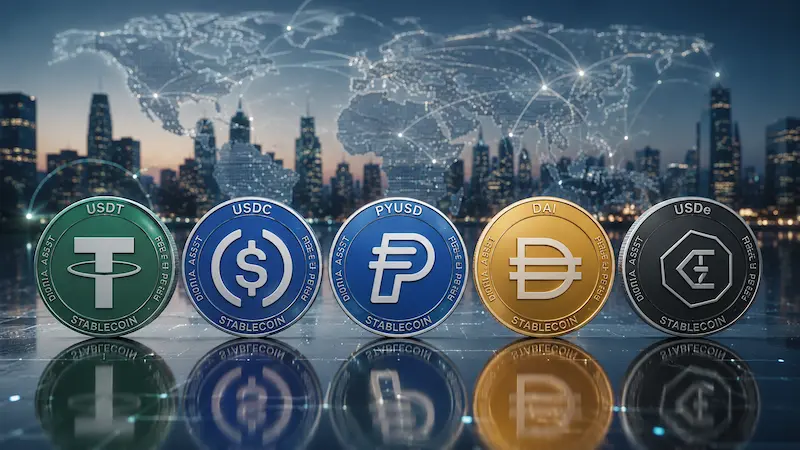

In 2024, stablecoins processed approximately $27.6 trillion in transaction volume — surpassing both Visa and Mastercard in total value transferred. That single statistic captures something that most mainstream financial commentary has been slow to recognise: stablecoins are no longer a niche crypto experiment. They are a functioning global payment infrastructure, growing faster than any payment network in history, and increasingly attracting the attention of regulators, central banks, and financial institutions worldwide.
The question is no longer whether stablecoins will play a significant role in global finance. They already do. The question is how large that role will become by 2030 — and what it means for traditional systems like bank wire transfers and the SWIFT network that has dominated international payments for over fifty years.
What Are Stablecoins and Why Do They Matter?
A stablecoin is a cryptocurrency designed to maintain a stable value by being pegged to a reference asset — most commonly the US Dollar. Unlike Bitcoin or Ethereum, which can fluctuate dramatically in price, stablecoins are engineered to hold a consistent value, making them practical for payments, savings, and value transfer in a way that volatile cryptocurrencies are not.
The two dominant stablecoins are USDT (Tether) and USDC (Circle), both pegged 1:1 to the US Dollar and backed by dollar reserves. Combined, they have a circulating supply exceeding $200 billion and are used daily by tens of millions of people across more than 100 countries for payments, remittances, trading, and savings.
Their significance extends beyond convenience. In countries experiencing currency instability — Argentina, Turkey, Nigeria, Lebanon — dollar-pegged stablecoins have become a genuine savings instrument for ordinary citizens seeking to protect their purchasing power against local currency devaluation. In Southeast Asia, Africa, and Latin America, they have become the preferred method for cross-border business payments, offering settlement in seconds at a fraction of the cost of traditional wire transfers.
How the SWIFT System Currently Works — and Its Limitations
SWIFT — the Society for Worldwide Interbank Financial Telecommunication — has been the backbone of international payment messaging since 1973. When you make an international wire transfer today, your bank sends a SWIFT message to your recipient's bank, often routing through one or more correspondent banks along the way. Each correspondent bank adds time, fees, and complexity to the transaction.
The result is a system that typically takes 1–5 business days to complete an international transfer, costs $15–50 in bank fees plus an exchange rate markup of 2–4%, requires both parties to have bank accounts, and operates only during banking hours on business days. For large institutional transactions, SWIFT works reliably. For individuals sending money internationally — particularly in emerging markets where banking access is limited — it is expensive, slow, and exclusionary.
You can verify any bank's SWIFT code and understand the routing process using FloatForex's free SWIFT/BIC lookup tool, which identifies any bank in the SWIFT network instantly. Understanding how traditional correspondent banking works makes it easier to appreciate exactly what stablecoins are offering as an alternative.
How Stablecoins Are Already Disrupting International Payments
The contrast between SWIFT and stablecoin transfers is stark. A $50,000 USDT transfer from London to Lagos on the Tron network takes approximately 3 minutes, costs less than $1, and requires no bank account on either end — only a smartphone and a crypto wallet. The same transfer via SWIFT would take 2–4 business days, cost $40–80 in fees, require bank accounts in both countries, and deliver the recipient a lesser amount after currency conversion markups.
This cost and speed differential is not marginal — it is transformational for the $800 billion annual global remittance market. Migrants sending money home to family in the Philippines, India, Nigeria, or Mexico are increasingly using stablecoins directly or through platforms built on stablecoin rails, saving hundreds of dollars per year in transfer fees. For small and medium-sized businesses conducting international trade, stablecoin settlements are eliminating the multi-day float costs and foreign exchange risk associated with traditional wire transfers.
Major payment processors including Visa, PayPal, and Stripe have all integrated stablecoin capabilities. PayPal launched its own dollar-pegged stablecoin, PYUSD, in 2023. Stripe reintegrated crypto payments in 2024 specifically using USDC. Visa is settling transactions with USDC on the Solana and Ethereum blockchains. These are not experimental pilots — they are live infrastructure decisions by the world's largest payment companies.
The Regulatory Landscape — A Turning Point for Stablecoins
The single most important development for stablecoins between 2024 and 2030 is regulatory clarity. For years, stablecoin issuers operated in a grey area — widely used but without clear legal frameworks defining how they should be regulated, what reserves they must hold, and what disclosures they must make. That is changing rapidly and in ways that will accelerate mainstream adoption rather than restrict it.
In the European Union, the Markets in Crypto-Assets (MiCA) regulation — which came into full effect in 2024 — established the world's most comprehensive stablecoin regulatory framework. MiCA requires stablecoin issuers to hold fully segregated, liquid reserves, publish regular audits, and obtain licensing from EU financial regulators. Compliant stablecoins now have legal equivalence to regulated electronic money in the EU — a watershed moment for legitimacy.
In the United States, the GENIUS Act — passed in 2025 — established a federal framework for payment stablecoins, requiring dollar reserves, regular audits, and compliance with anti-money laundering regulations. For the first time, US-regulated banks are permitted to issue stablecoins, opening the door to products from JPMorgan, Citi, and other major institutions. This legitimisation is expected to drive a significant expansion in stablecoin supply and adoption over the following years.
The United Kingdom, Singapore, UAE, Japan, and Australia have all either passed or are actively developing stablecoin regulatory frameworks. The global direction of travel is clear: stablecoins are being integrated into the regulated financial system, not excluded from it.
Central Bank Digital Currencies — Competition or Complement?
No discussion of stablecoins' future is complete without addressing central bank digital currencies (CBDCs). More than 130 countries are at some stage of CBDC research, development, or pilot deployment. The digital yuan (e-CNY) has been in active circulation in China since 2020 with tens of millions of users. The European Central Bank is advancing the digital euro. The US Federal Reserve is researching a digital dollar.
The critical distinction is that CBDCs are issued and controlled directly by central banks — they are digital versions of existing fiat currency, with all the surveillance, programmability, and centralised control that implies. Stablecoins issued by private entities like Tether and Circle operate differently — they are pegged to fiat currencies but run on decentralised or semi-decentralised blockchain networks.
The consensus among financial analysts is that CBDCs and private stablecoins will coexist and serve different purposes rather than one replacing the other. CBDCs are likely to dominate domestic retail payments in countries that implement them. Private stablecoins are likely to maintain dominance in international transfers, DeFi applications, and use cases where programmability and interoperability across networks are valued over state control.
Will Stablecoins Replace SWIFT by 2030?
The direct answer is no — but the question itself reveals a misunderstanding of how payment infrastructure evolves. SWIFT is not simply a payment method — it is a messaging standard connecting over 11,500 financial institutions in more than 200 countries, with decades of regulatory trust, compliance infrastructure, and institutional relationships built into it. It will not be replaced in six years.
What is far more likely — and is already happening — is a bifurcation of the international payments market. SWIFT will continue to handle large institutional transactions, high-value corporate treasury movements, and payments between financial institutions where regulatory compliance and institutional trust are paramount. Stablecoins will increasingly capture consumer remittances, small and medium business payments, emerging market transactions, and any use case where speed, cost, and accessibility are the primary considerations.
By 2030, the most credible scenario is that stablecoin-based payment rails handle 15–25% of global cross-border payment volume — not replacing SWIFT but operating alongside it as a parallel infrastructure serving a different market segment. That would still represent a multi-trillion dollar shift in payment flows from traditional banking to blockchain-based settlement.
For anyone regularly sending money internationally — whether for personal remittances or business payments — understanding the true cost of traditional wire transfers versus stablecoin alternatives starts with knowing the live exchange rates. FloatForex's live currency converter shows real-time mid-market rates for 60+ currencies, giving you a benchmark to compare against any quote from a bank or transfer service.
The Implications for Banks and the Financial System
For traditional banks, the rise of stablecoin payment rails presents a genuine strategic challenge. A significant portion of bank revenue from international payments comes from the spread between the rates they offer customers and the interbank rates at which they actually trade — in effect, a hidden fee that most customers do not explicitly see. As stablecoins offer transparent, near-zero-cost international settlement, this revenue source faces structural erosion.
The banking sector's response has been a mixture of integration and competition. JPMorgan's JPM Coin has processed over $1 billion in daily transactions between institutional clients since 2019. Société Générale issued a euro stablecoin on the Ethereum blockchain in 2023. Swift itself has run multiple blockchain interoperability pilots, recognising that its long-term relevance depends on connecting to blockchain-based payment networks rather than competing with them.
The most likely outcome is that large banks become issuers and custodians of regulated stablecoins rather than fighting their adoption — capturing the distribution and trust advantages they already hold while adapting their infrastructure to blockchain settlement rails.
What This Means for Your Personal Finances and International Transfers
For individuals and small businesses, the practical implications of stablecoin growth are already tangible and will become more so through 2030. If you regularly send money internationally, stablecoin-based transfer platforms are already significantly cheaper and faster than traditional bank wires in most corridors. If you receive income in one currency and need to convert or save in another, dollar-pegged stablecoins held on a regulated platform offer an alternative to bank savings accounts with potentially faster conversion and transfer capabilities.
The key risk to manage is platform risk — not all stablecoin issuers or exchanges are equally regulated or solvent. The collapse of algorithmic stablecoin Terra/Luna in 2022 wiped out $40 billion in value in days, demonstrating that not all stablecoins carry the same risk profile. Regulated, fully-reserved stablecoins like USDC — which publishes monthly reserve attestations from major accounting firms — carry a fundamentally different risk profile from algorithmic or poorly-reserved alternatives.
For IBAN validation on international transfers involving both traditional and crypto payment rails, FloatForex's free IBAN validator instantly verifies account numbers for 60+ countries, reducing the risk of misdirected transfers.
The Bottom Line
Stablecoins have already crossed the threshold from experimental to essential in global finance. The $27 trillion in 2024 transaction volume, the regulatory frameworks now in place across major economies, and the integration of stablecoin infrastructure by Visa, PayPal, and Stripe are not indicators of future potential — they are evidence of present reality.
By 2030, stablecoins will not have replaced SWIFT or the traditional banking system. But they will have permanently changed the competitive landscape for international payments, forced banks to adapt their fee structures and infrastructure, and given hundreds of millions of people access to fast, cheap, borderless dollar-denominated transfers that were previously available only to institutions.
The financial plumbing of the world is being rebuilt — quietly, incrementally, and faster than most people realise. Understanding stablecoins today puts you ahead of the vast majority of people who will be using them tomorrow without ever knowing what they are.