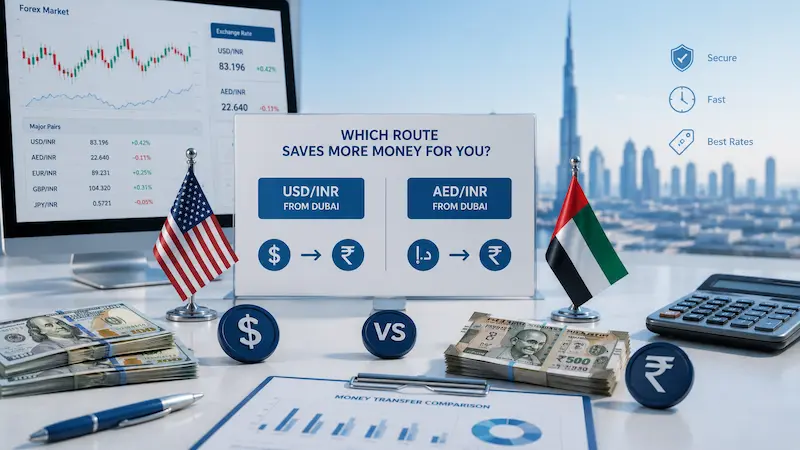

If you live in Dubai, Abu Dhabi, or anywhere in the UAE and regularly send money home to India, one question comes up every single time: should you convert USD to INR or AED to INR to get the most rupees?
It sounds like a simple question. But with live exchange rates shifting by the minute, hidden bank margins, double-conversion fees, and platform-specific spreads, the answer genuinely changes day by day — sometimes hour by hour.
This guide breaks down the USD to INR vs AED to INR comparison using real numbers, a step-by-step calculation method, and the one tool that lets you compare both routes in real time before every transfer.
1. USD to INR vs AED to INR — The Direct Answer
Because the UAE Dirham is pegged to the US Dollar at a fixed 3.6725 AED per USD, the exchange rate difference between the two routes is usually negligible — typically less than 0.05 percent at mid-market rates. The route that gives you more rupees is determined almost entirely by platform fees and conversion margins, not the headline exchange rate. Direct AED to INR usually wins for AED earners using competitive UAE exchange houses; USD to INR wins if you already hold dollars or use a USD-priced platform.
Here are the two conversion routes in detail:
Route 1 — Direct AED to INR
You convert UAE Dirhams directly into Indian Rupees. Most remittance apps and exchange houses in the UAE offer this as a standard service. Your AED is converted once, and the INR lands in the recipient's account.
Route 2 — USD to INR (via dollar)
You convert AED to USD first, then USD to INR. Many international platforms — including US-based remittance services used by Indian expats in America — use USD as the base currency for India transfers. If you hold USD, or if your platform prices transfers in dollars, this is your route.
The critical insight most people miss: Because the UAE Dirham has been pegged to the US Dollar at a fixed rate of 3.6725 AED per USD since 1997, the AED and USD move in lockstep. This means what makes one route better than the other on any given day is almost entirely about fees, platform margins, and transfer costs — not the headline rate. For the full explanation of how the peg works, see our guide: Why Is the UAE Dirham Pegged to the US Dollar?
2. How to Calculate Which Route Gives More Rupees
Before sending any amount, run this quick calculation:
Route 1 — Direct AED to INR:
INR received = AED amount × AED/INR rate
Route 2 — Via USD to INR:
INR received = AED amount × (AED/USD rate) × (USD/INR rate)
Real example using mid-market rates:
| Variable | Value |
|---|---|
| AED/INR rate | 22.75 |
| AED/USD rate | 0.2723 (fixed peg) |
| USD/INR rate | 83.60 |
Route 1 — Direct AED to INR:
AED 5,000 × 22.75 = ₹1,13,750
Route 2 — Via USD to INR:
AED 5,000 × 0.2723 × 83.60 = ₹1,13,759
In this example the two routes are nearly identical at mid-market rates — confirming that the AED/USD peg neutralises most of the rate difference. The winner is determined entirely by which platform charges lower fees.
Now factor in fees:
| Platform Type | Typical Margin | Fee on AED 5,000 |
|---|---|---|
| High street bank | 2.5–3.5% | ₹2,844–₹3,981 lost |
| Traditional exchange house | 1.0–2.0% | ₹1,138–₹2,275 lost |
| Online platform (Wise, Remitly) | 0.3–0.8% | ₹341–₹910 lost |
This is why comparing platforms — not just rates — is the most important step before every transfer.
3. When USD to INR Wins — Four Scenarios
The USD to INR route gives you more rupees in these specific situations:
Scenario A — You hold USD already
If you receive salary in USD or have USD savings, converting directly to INR avoids the AED conversion step entirely. Every conversion step adds a fee and spread, so fewer steps means more rupees.
Scenario B — Dollar strengthens globally
When the US Dollar strengthens — typically during Fed rate hikes, global risk-off sentiment, or geopolitical uncertainty — the USD/INR rate often rises faster than AED/INR adjusts. In these windows, USD to INR may temporarily offer a better effective rate.
Scenario C — Your platform prices in USD
If you use a US-based platform like Remitly USA, Wise from a USD account, or a bank wire from an American account, you are already on the USD to INR route by default. The question is simply which USD-priced platform offers the best USD/INR rate.
Scenario D — RBI reference rate favours dollar conversions
The Reserve Bank of India publishes a daily reference rate for USD/INR. Some platforms guarantee this rate with minimal markup. When the RBI reference rate is high, USD to INR transfers through these platforms can deliver more rupees than indirect AED routes with higher margins.
4. When AED to INR Wins — Four Scenarios
Scenario A — You earn in AED
For the 3.4 million Indians living and working in the UAE, AED is the natural starting currency. Converting AED directly to INR eliminates the intermediate AED-to-USD step and its associated cost.
Scenario B — UAE platforms offer competitive AED/INR rates
UAE-based remittance platforms including Al Ansari Exchange, LuLu Exchange, and UAE Exchange compete aggressively on AED to INR rates, often offering rates closer to the mid-market than international platforms pricing in USD.
Scenario C — You want to avoid double conversion
Going AED → USD → INR involves two conversion spreads. For large transfers above AED 10,000, this double-conversion cost can erode ₹500–₹2,000 compared to a direct AED to INR transfer.
Scenario D — Promotional rates are available
UAE exchange houses frequently offer promotional AED to INR rates — particularly around Diwali, Eid, and India-UAE trade events. These can temporarily make the direct route significantly better.
5. Step-by-Step Guide — What to Do Before Every Transfer to India
- Check live mid-market rates for both pairs — Go to FloatForex's live USD to INR page and live USD to AED page. These mid-market rates are your benchmark before any platform adds its margin.
- Calculate expected INR on both routes — Use the formula above. Compare the raw INR amounts at mid-market rates for both pairs using the FloatForex live converter.
- Get quotes from 2–3 platforms — Compare the final INR amount (after all fees) on at least two platforms — one UAE-based (Al Ansari, UAE Exchange) and one international (Wise, OFX). The total INR received is what matters, not the advertised rate.
- Validate the recipient's Indian bank details — Confirm the IFSC code and account number before any transfer. Use FloatForex's free IBAN Validator and SWIFT/BIC lookup to verify receiving bank details.
- Time your transfer around market events — Avoid transferring immediately before or after RBI monetary policy announcements (6 times per year) or US Federal Reserve decisions. These can move USD/INR and AED/INR by 0.5–1% in minutes — worth ₹1,000–₹2,000 on AED 10,000.
6. Real Example — AED 10,000 Transfer From Dubai to Mumbai
Complete comparison for someone sending AED 10,000 from Dubai to Mumbai:
Mid-market rates: AED/INR: 22.75 | USD/INR: 83.60 | AED/USD: 0.2723
Mid-market INR:
Route 1 (AED → INR): AED 10,000 × 22.75 = ₹2,27,500
Route 2 (AED → USD → INR): AED 10,000 × 0.2723 × 83.60 = ₹2,27,581
Difference at mid-market: just ₹81 — negligible.
Now the same transfer through real platforms with fees applied:
| Platform | Route | Typical Margin | Final INR Received |
|---|---|---|---|
| Bank wire (UAE bank) | AED → INR | 3.0% | ₹2,20,675 |
| Bank wire (via USD account) | AED → USD → INR | 3.5% (double spread) | ₹2,19,616 |
| UAE exchange house (Al Ansari, LuLu) | AED → INR | 1.5% | ₹2,24,088 |
| Online platform (Wise) | AED → INR | 0.6% | ₹2,26,135 |
| Online platform (USD account) | USD → INR | 0.5% | ₹2,26,443 |
The result: The difference between the best option (₹2,26,443) and the worst option (₹2,19,616) is ₹6,827 on a single AED 10,000 transfer — entirely due to platform fees, not the route chosen. For someone sending money home every month, choosing the right platform saves over ₹80,000 per year. The route question matters far less than the platform question.
7. Tax and Regulatory Considerations for UAE to India Transfers
Beyond rates and fees, NRIs sending money from the UAE to India should understand the regulatory side of remittances:
On the UAE side — there is no limit on outward personal remittances from the UAE. The UAE imposes no tax on remittances, and licensed exchange houses and banks handle compliance reporting automatically for standard transfers.
On the India side — money received from a relative working abroad is generally treated as a tax-free gift or family maintenance under Indian tax law. However, two practical points matter: transfers into an NRE (Non-Resident External) account are fully repatriable and the interest earned is tax-free in India, while transfers into a regular savings account or NRO account may have different tax treatment on interest earned. For large or irregular transfers, keeping documentation of the source of funds is recommended.
For property purchases or investments in India — remittances used for buying property or investing in Indian markets must comply with FEMA (Foreign Exchange Management Act) regulations. Most NRI investments route through NRE/NRO accounts, and the receiving bank will guide the documentation requirements.
Frequently Asked Questions — Sending Money From UAE to India
Is it better to send USD or AED to India?
At mid-market rates, the two routes are nearly identical because the AED is pegged to the USD at 3.6725. The better route depends on which currency you hold and which platform offers the lowest total fees. If you earn in AED, a direct AED to INR transfer through a low-fee platform usually delivers the most rupees. If you already hold USD, converting directly to INR avoids an extra conversion step and its cost.
What is the cheapest way to send money from Dubai to India?
Online remittance platforms with margins of 0.3–0.8 percent — such as Wise and Remitly — consistently deliver more rupees than bank wires (2.5–3.5 percent margins) or traditional exchange houses (1–2 percent). Always compare the final INR amount received after all fees, not the advertised exchange rate, and check the live mid-market benchmark first so you know exactly what each platform is charging above the real rate.
Why does the AED to INR rate change if the AED is pegged?
The AED is pegged to the USD — not to the INR. The Indian Rupee floats freely against the dollar, so when USD/INR moves, AED/INR moves proportionally with it. The peg only guarantees the AED/USD leg stays fixed at 3.6725; the rupee side of the equation changes continuously with market conditions, RBI policy, and capital flows.
When is the best time to send money to India from the UAE?
The rupee typically weakens — giving you more INR per dollar or dirham — during periods of global dollar strength, US Federal Reserve rate hikes, or rising oil prices, since India is a major oil importer. Avoid transferring in the minutes around RBI or Fed policy announcements when rates can swing 0.5–1 percent. Monitoring the live USD/INR rate for several days before a large transfer helps you catch a favourable window.
How much money can I send from the UAE to India?
There is no UAE-side limit on outward personal remittances. On the India side, money received from family abroad is generally tax-free for the recipient, though large or irregular transfers may require documentation of the source of funds. Transfers into NRE accounts are fully repatriable with tax-free interest, while NRO accounts have different tax treatment. For business transfers, both jurisdictions require appropriate invoicing.
Conclusion — The Route Matters Less Than the Platform
The USD to INR vs AED to INR question has a clear answer in 2026: thanks to the AED/USD peg, the two routes are nearly identical at mid-market rates — within ₹100 on a typical AED 10,000 transfer. What separates a good transfer from an expensive one is the platform's margin — a gap worth up to ₹6,800 per transfer, or ₹80,000+ per year for monthly senders.
The winning routine is simple: check the live mid-market USD/INR and AED/INR benchmark rates first, get final-amount quotes from at least two platforms, validate the recipient's bank details, and avoid transferring around central bank announcements. Five minutes of comparison before every transfer consistently saves thousands of rupees.
Compare live rates before your next transfer — free, no login required:
Live USD to INR Rate |
Live USD to AED Rate |
AED to INR Converter |
All 150+ Currency Rates |
IBAN Validator |
SWIFT/BIC Lookup
Note: This article is for educational purposes only and does not constitute financial or tax advice. Exchange rates shown are illustrative examples. Always verify live rates, platform fees, and applicable regulations before transferring money internationally.