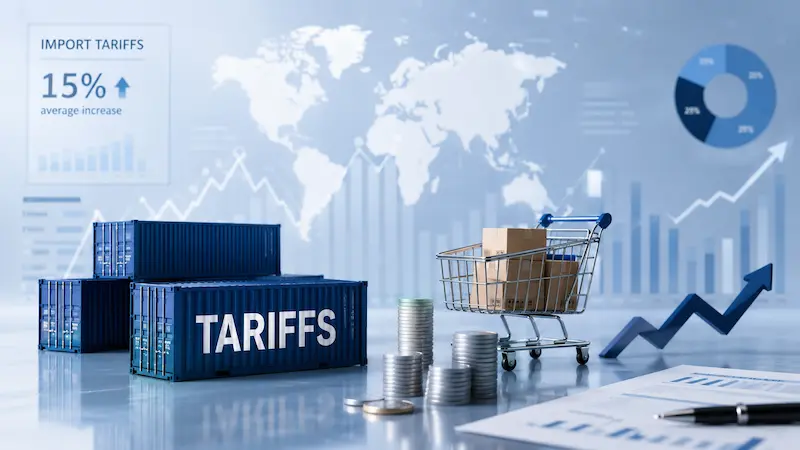

Walk into any supermarket, electronics store, or car dealership in 2026 and something feels different. Prices are higher than they were two years ago — not just marginally higher, but noticeably, persistently higher across a wide range of goods. Many people blame inflation broadly. But behind a significant portion of that price pressure sits a specific policy tool that most consumers know little about: tariffs.
Understanding what tariffs are, how they work, and why they cause inflation is no longer just an academic exercise. In 2026, tariff policy has become one of the most consequential economic forces affecting household budgets, exchange rates, and the broader global economy. This analysis breaks it all down in plain language — without the political noise, just the economic mechanics.
What Is a Tariff? — The Direct Definition
A tariff is a tax imposed by a government on goods imported from foreign countries. When a country imposes a tariff on, say, imported steel, every tonne of foreign steel entering the country is subject to an additional charge — paid to the government by the importing company at the border. The tariff is calculated as a percentage of the value of the imported goods.
Tariffs have existed for centuries. Historically they served two primary purposes: generating government revenue and protecting domestic industries from cheaper foreign competition. In the modern globalised economy they have taken on a third role — as instruments of geopolitical leverage, used to pressure trading partners during diplomatic and trade disputes.
What makes tariffs distinct from other taxes is who ultimately pays them. The tariff is technically charged to the importing company. But as Federal Reserve research has consistently shown, importing companies do not absorb these costs themselves — they pass them forward through the supply chain, ultimately landing on consumers in the form of higher prices.
How Do Tariffs Cause Inflation? — The 5-Step Chain
The connection between tariffs and inflation is direct but not always immediate. Understanding the transmission mechanism helps explain why prices often rise months after tariffs are first announced.
The chain works like this:
- Government imposes a tariff on imported goods at the border.
- Importing companies pay higher costs when their goods clear customs.
- Wholesale prices rise as importers protect their profit margins.
- Retailers pay more for inventory and adjust their shelf prices upward.
- Consumers pay the final bill for goods that previously cost less.
This process does not happen overnight. Federal Reserve research published in April 2026 found that the full effect of tariffs on consumer prices takes approximately seven months to manifest — meaning price increases from tariffs announced in early 2025 were still feeding through to consumer prices well into 2026. As the research concluded: for every extra dollar companies pay to import a good, sooner or later, consumers will see it added to their bill.
The scale of this impact has been significant. According to Federal Reserve economists, tariffs implemented through 2025 raised core goods consumer prices by 3.1 percent through February 2026 — accounting for the entirety of excess inflation in the core goods category relative to pre-pandemic rates. The Dallas Federal Reserve estimated that tariff effects added approximately 0.80 percentage points to core inflation in the twelve months to March 2026.
What Is the Current US Tariff Rate in 2026?
The average US tariff rate in 2026 stands at between 10 and 13 percent depending on the category of goods — the highest average tariff level since the 1940s. This represents a dramatic increase from the pre-2025 baseline of around 2 to 3 percent on most goods.
The categories most heavily affected by tariffs include electronics, automobiles and auto parts, steel and aluminium products, furniture, appliances, clothing and textiles, and agricultural goods. A New York Federal Reserve analysis found that US consumers and companies were bearing approximately 90 percent of these tariff costs — meaning the burden has largely not been absorbed by foreign exporters as originally suggested by proponents of the tariff policy.
The Tax Foundation calculated that the 2025 tariff regime represented an average tax increase of $1,000 per US household. For 2026, even accounting for some tariff reductions, the estimate remains approximately $700 per household — a real and measurable reduction in purchasing power for ordinary American families.
The Tariff Impact in Numbers — Quick Reference
| Metric | 2026 Reading | Source |
|---|---|---|
| Average US tariff rate | 10–13% | Highest since 1940s |
| Pre-2025 baseline tariff rate | 2–3% | US Trade Representative |
| Tariff cost passed to US consumers/companies | ~90% | NY Federal Reserve |
| Core goods inflation from tariffs | +3.1% through Feb 2026 | Federal Reserve research |
| Contribution to core inflation (12 months) | +0.80 percentage points | Dallas Fed |
| Time for full price pass-through | ~7 months | Federal Reserve research |
| Average tariff cost per US household (2025) | ~$1,000 | Tax Foundation |
| Average tariff cost per US household (2026) | ~$700 | Tax Foundation |
| Cumulative goods price rise 2025–2027 forecast | 4.5–5.6% | Morningstar |
| US recession probability (next 12 months) | ~35% | Reuters poll of 103 economists |
Do Tariffs Always Cause Inflation?
The relationship between tariffs and inflation is real but more nuanced than a simple one-to-one correspondence. Research from the San Francisco Federal Reserve published in March 2026 found that in the short run, tariff increases can actually suppress inflation by depressing consumer demand — when people feel financially squeezed they spend less, which reduces demand-pull inflation pressure.
However, the same research found that over time tariff increases are gradually passed through to prices, raising inflation. The short-term demand suppression gives way to the longer-term price increase as the full cost passes through the supply chain. This delayed effect is precisely why inflation can appear puzzling — it rises after a lag that obscures the original cause.
What is clear from 2025 and 2026 data is that tariffs have had a clear, measurable impact on specific categories: furniture, appliances, electronics, and clothing have all shown statistically significant price increases correlated with tariff implementation. Even goods manufactured domestically have not been immune — many US manufacturers import components like microchips, batteries, and raw materials from abroad, meaning tariff costs enter their production process regardless of where final assembly occurs.
How Do Tariffs Affect Exchange Rates and Currency?
This is where tariffs become directly relevant to currency markets, forex rates, and financial tools like live exchange rate trackers.
Tariffs affect exchange rates through several interconnected channels. When a country imposes tariffs, it reduces its demand for foreign goods — meaning it buys fewer imports and therefore needs to purchase less foreign currency to pay for them. This reduced demand for foreign currency can strengthen the domestic currency. This is one reason the US dollar has maintained relative strength during periods of high tariff imposition.
However, the relationship is complicated by retaliation. When the US imposes tariffs on Chinese goods, China typically retaliates with tariffs on US exports. This bilateral tariff war reduces trade flows in both directions, creating economic uncertainty that causes capital to flow toward safe haven assets — which in financial markets means US Treasury bonds and the US dollar. Safe haven demand for the dollar can strengthen it against currencies like the Chinese yuan, the euro, and emerging market currencies including the Pakistani rupee and Indian rupee.
The inflation dimension adds another layer. If tariffs push US inflation significantly higher, the Federal Reserve may be forced to keep interest rates elevated longer than it otherwise would. Higher US interest rates attract global capital seeking better returns, further strengthening the dollar. This dollar strength makes US exports more expensive for foreign buyers — a competitiveness cost that often offsets some of the trade protection tariffs were intended to provide.
You can monitor how tariff-related dollar movements are affecting live exchange rates for USD against EUR, GBP, PKR, INR, AED and 150+ other currencies in real time at FloatForex's live currency rates page — updated continuously throughout the trading day.
How Do Tariffs Affect Gold Prices?
Gold has a well-established relationship with tariff-driven economic uncertainty. When tariff disputes escalate and global trade uncertainty rises, investors historically move toward gold as a safe haven asset — pushing XAU/USD prices higher.
The mechanism is straightforward. Tariff escalation creates economic uncertainty. Uncertainty reduces investor risk appetite. Reduced risk appetite drives capital toward safe haven assets. Gold, which carries no counterparty risk and is universally recognised, benefits from this flight to safety. The same Federal Reserve policy response that tariffs provoke — keeping interest rates higher for longer to combat inflation — can complicate the gold trade, since higher interest rates reduce the appeal of non-yielding assets like gold. But geopolitical and economic uncertainty has historically outweighed interest rate headwinds for gold during major tariff cycles.
Gold's record-breaking rally to $5,589 per ounce in January 2026 was driven in significant part by tariff-driven uncertainty alongside structural central bank buying. For a complete analysis of where gold is heading, see our detailed Gold Price Forecast 2026 — Will XAU/USD Hit $5,000, $6,000 or Higher? guide. Track live XAU/USD gold prices in real time at FloatForex's gold charts.
The Economic Outlook for Tariffs and Inflation in 2026
Morningstar forecasts durables prices to rise a cumulative 4.5 percent and non-durables 5.6 percent over 2025 to 2027 as a result of tariff pass-through. GDP growth is expected to bottom out in late 2026 or early 2027 before improving as tariff effects fade and the Federal Reserve's rate cuts take hold.
Consumer spending growth has slowed to 1.9 percent in 2026 — down from stronger pre-tariff levels — as households redirect income toward higher-priced necessities and rebuild savings rates that fell significantly below historical averages. The personal savings rate of 4.8 percent still significantly lags the 7.3 percent average seen in 2019, suggesting household balance sheets remain stretched.
Reuters polling of 103 economists puts the probability of a US recession at approximately 35 percent over the next 12 months — down from 45 percent earlier in 2026, partly due to optimism around tariff deal negotiations. But the consensus view is that tariff-driven inflation will remain above the Federal Reserve's 2 percent target through the end of 2026, with CPI expected at approximately 2.8 percent for the full year. For the full set of recession warning indicators worth watching, see our Is a Recession Coming? 7 Warning Signs guide.
What Tariffs Mean for Your Money — Practical Implications
For ordinary consumers and investors trying to navigate a tariff-affected economy, the practical implications are several:
Your purchasing power is reduced. The Tax Foundation's estimate of $700 per household in additional costs from 2026 tariffs is not an abstract figure — it represents real goods and services that households can no longer afford at the same rate as before. The most affected categories are everyday purchases: electronics, clothing, furniture, and some food products.
Your savings face a real return challenge. When inflation runs at 2.8 percent and savings accounts pay less than that in real terms, every year of delay in investing or accessing better-yielding accounts costs you real purchasing power. Understanding the compound effect of inflation on savings over time is important — you can calculate exactly how inflation erodes the real value of your savings using the compound interest calculator at FloatForex's compound calculator. For specific inflation-hedging strategies, see our guide on how to protect your money from inflation.
Exchange rates matter more for international activities. If you send remittances abroad, travel internationally, or run a business with cross-border payments, tariff-driven dollar strength or weakness directly affects the value you send or receive. Checking the live USD to EUR, USD to GBP, or USD to PKR rate before any conversion ensures you are working from the real mid-market rate rather than a bank's marked-up version.
Gold may serve as a portfolio hedge. During tariff-driven economic uncertainty, gold has historically preserved purchasing power better than cash. The live gold price at FloatForex's gold charts gives you real-time XAU/USD data to track how gold is performing relative to the broader tariff and inflation environment.
Tariffs in Historical Context — Smoot-Hawley and Today
To understand the significance of the current tariff environment, it helps to place it in historical context. The last time the US maintained average tariff rates this high was before the post-World War II international trade liberalisation era. The Smoot-Hawley Tariff Act of 1930 — which raised US tariffs to historic highs during the Great Depression — is widely cited by economists as having deepened the global depression by triggering retaliatory tariffs from trading partners and collapsing international trade volumes.
The current situation is not directly comparable to Smoot-Hawley — the global economy is more diversified, supply chains are more complex, and international institutions provide buffers that did not exist in 1930. But the core economic lesson remains relevant: tariffs imposed unilaterally typically invite retaliation, and retaliatory cycles reduce trade for all parties while raising prices for consumers on both sides of the dispute.
What is different in 2026 is the speed of information. Exchange rates, gold prices, and consumer price data reflect tariff developments within hours of announcements — markets are faster and more globally connected than at any previous point in history. This makes real-time financial data more valuable than ever for anyone trying to understand and navigate tariff-affected markets.
Frequently Asked Questions — Tariffs and Inflation 2026
What is a tariff in simple terms?
A tariff is a tax charged on goods imported from other countries. The importing company pays the tax at the border, but research consistently shows that approximately 90 percent of tariff costs are ultimately passed to consumers through higher prices for goods.
Do tariffs cause inflation?
Yes — tariffs cause inflation by raising the cost of imported goods, which flows through supply chains to consumer prices over a period of approximately seven months. Federal Reserve research found that 2025 tariffs raised core goods consumer prices by 3.1 percent through February 2026, contributing 0.80 percentage points to overall core inflation.
How much have tariffs cost the average American household?
According to the Tax Foundation, the 2025 tariff regime represented an average tax increase of approximately $1,000 per US household. For 2026, even with some tariff reductions, the estimate remains approximately $700 per household in additional costs.
How do tariffs affect the US dollar exchange rate?
Tariffs can strengthen the US dollar in the short term by reducing import demand for foreign currency and by forcing the Federal Reserve to keep interest rates higher to combat tariff-driven inflation. Higher US interest rates attract global capital, increasing demand for dollars. You can monitor live USD exchange rates against all major currencies at FloatForex's currencies page.
How do tariffs affect gold prices?
Tariff escalation tends to support gold prices by creating economic uncertainty that drives investor demand for safe haven assets. When trade disputes intensify, investors typically increase gold allocations, pushing XAU/USD prices higher. Track live gold prices at FloatForex's gold charts.
Will tariffs still be affecting inflation in 2027?
Morningstar projects cumulative goods price increases from tariffs of 4.5 to 5.6 percent over 2025 to 2027. However, most economic forecasters expect tariff effects to gradually fade from 2027 onward as supply chains adjust, trade deals are negotiated, and the Federal Reserve's rate cuts take effect.
What is the current US tariff rate?
The average US tariff rate in 2026 stands at 10 to 13 percent depending on the goods category — the highest level since the 1940s. Even if certain tariffs expire in mid-2026, the rate would drop to approximately 6 to 9 percent — still historically elevated compared to the 2 to 3 percent average that characterised US trade policy for most of the post-war era.
Who actually pays for tariffs — foreign exporters or American consumers?
Despite political claims that tariffs are paid by foreign exporters, multiple Federal Reserve studies including a New York Fed analysis have found that approximately 90 percent of US tariff costs are borne by American consumers and companies — not by the foreign countries being tariffed. The tariff is technically collected from the importing company at the border, but the cost is passed through the supply chain to retail prices.
What is the difference between a tariff and a sanction?
A tariff is a tax on imported goods that still allows trade to continue at a higher cost. A sanction is a restriction or prohibition on trade with a specific country, company, or individual — often blocking transactions entirely rather than just making them more expensive. Tariffs are typically used as economic leverage in trade negotiations, while sanctions are more often used as geopolitical or national security tools.
Conclusion — Tariffs Are Now a Permanent Feature of Your Financial Reality
Tariffs in 2026 are not a temporary headline — they are a structural feature of the economic environment shaping consumer prices, exchange rates, and asset markets. Federal Reserve research has now established beyond doubt that tariffs are causing measurable inflation, costing American households hundreds of dollars per year, and contributing to slower growth and elevated recession risk.
The economic mechanics are clear: tariffs raise import costs, importers pass costs to retailers, retailers pass costs to consumers, and consumers pay more for the same goods. The process takes about seven months from policy announcement to full price pass-through. By 2027 the cumulative goods price increase from this tariff cycle will be 4.5 to 5.6 percent.
Understanding this dynamic puts you in a better position than most consumers — who blame inflation broadly without recognising the specific policy mechanism behind it. Monitoring live exchange rates, gold prices, and inflation hedges gives you real-time visibility into how tariff policy is shifting the value of your money in 2026.
Track the financial impact of tariffs in real time — free, no login required:
Live Currency Rates — 150+ Pairs |
Live Gold Price — XAU/USD Chart |
Compound Interest Calculator |
What Is Stagflation? 2026 Analysis |
Is a Recession Coming? 7 Warning Signs |
How to Protect Your Money From Inflation |
Gold Price Forecast 2026
Note: This article is for educational purposes only and does not constitute financial or investment advice. Economic conditions and tariff policies evolve rapidly. Always consult a qualified financial advisor before making investment or financial planning decisions.