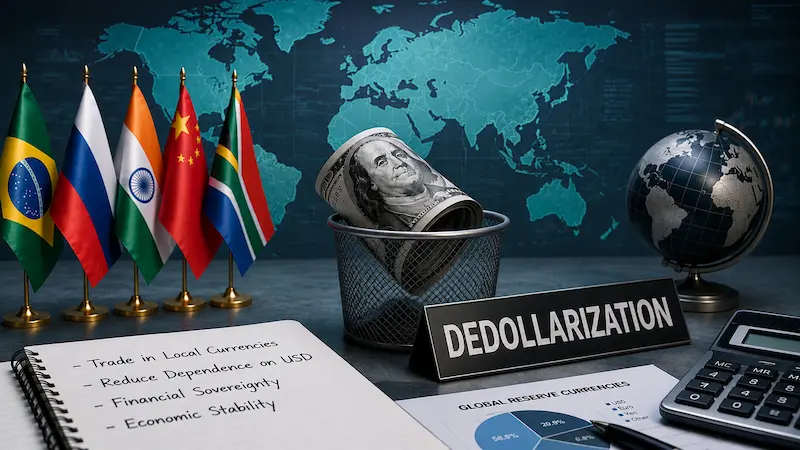

For seventy years, the US Dollar has been the undisputed language of global finance. Oil is priced in dollars. International trade is settled in dollars. Central banks hold dollars as their primary reserve asset. This arrangement — known as dollar hegemony — has given the United States extraordinary financial power.
That arrangement is changing. Not collapsing overnight — but shifting in ways that are measurable, accelerating, and consequential for anyone who holds savings, sends money internationally, or tracks currency markets.
This is a complete guide to what dedollarization is, why it is happening now, which countries are leading it, and what it means practically for exchange rates, gold, and your money.
1. What Is Dedollarization — The Direct Definition
Dedollarization is the process by which countries, central banks, and international institutions reduce their reliance on the US Dollar for three specific functions:
- Trade settlement — instead of paying for imports and exports in dollars, countries use their own currencies or other alternatives directly.
- Foreign exchange reserves — instead of holding the majority of their reserves as US Dollars and US Treasury bonds, central banks diversify into other currencies, gold, or alternative assets.
- Commodity pricing — instead of pricing oil, natural gas, and gold in dollars, switching to alternative pricing in local currencies or baskets of currencies.
Dedollarization does not mean the dollar disappears. It means the dollar's share of global finance shrinks from its current dominant position toward something more proportional to the United States' actual share of global economic output — approximately 25 percent, compared to the dollar's current 58 percent share of global foreign exchange reserves.
2. The Petrodollar System — Why the Dollar Became Dominant
To understand why dedollarization matters, you need to understand the system it is challenging.
In 1944, the Bretton Woods agreement made the US Dollar the anchor of the global monetary system. When the US ended dollar-gold convertibility in 1971, dominance was maintained through a different mechanism — the petrodollar.
In 1974, the United States and Saudi Arabia reached a pivotal agreement. Saudi Arabia and OPEC nations would price and sell oil exclusively in US Dollars. In return, the United States would provide military protection and security guarantees to Gulf states. This created structural global demand for dollars — any country that needed to buy oil needed to hold dollars first. Since almost every country buys oil, almost every country needed dollars.
The consequences were profound. Dollar demand remained consistently high regardless of US economic performance. The US could run persistent trade deficits without the currency collapse that would normally follow. US government debt was financed cheaply because foreign central banks needed to park their dollar reserves in US Treasury bonds.
This is the system that dedollarization is beginning to challenge.
3. Why Dedollarization Is Accelerating in 2026 — The Four Drivers
Driver 1 — The Weaponization of the Dollar
The single most powerful accelerant of dedollarization was a decision made in February 2022. Following Russia's invasion of Ukraine, the United States and its allies froze approximately $300 billion in Russian central bank assets held in Western financial institutions. In a single week, the world's governments watched as what they thought were sacrosanct foreign exchange reserves were rendered inaccessible.
The message received by governments worldwide — particularly those with complicated relationships with Washington — was unambiguous. Dollar reserves are not simply economic assets. They are assets that can be frozen, confiscated, or weaponised as geopolitical leverage. Every central bank holding dollars suddenly understood that their reserves were not truly sovereign.
Driver 2 — The Rise of BRICS
The BRICS bloc has evolved into the most significant institutional vehicle for dedollarization. In 2024, BRICS expanded to include Saudi Arabia, the UAE, Iran, Egypt, Ethiopia and Argentina — creating a grouping that represents over 45 percent of the world's population and approximately 35 percent of global GDP measured at purchasing power parity.
The expanded BRICS has been actively discussing alternatives to dollar-dominated trade settlement — including a common BRICS trade currency backed by a basket of member currencies and commodities. Russia and India now conduct significant portions of bilateral trade in rupees. China and Saudi Arabia have conducted oil transactions settled in Yuan.
Driver 3 — China's Yuan Internationalisation
China has been systematically building the infrastructure needed to make the Yuan a viable alternative to the dollar. The Cross-Border Interbank Payment System (CIPS) — China's alternative to the SWIFT messaging network — now processes trillions of Yuan-denominated transactions annually. The digital Yuan (e-CNY) has been in active circulation since 2020.
China is also the world's largest oil importer. As China increasingly demands that oil exporters accept Yuan payments — and as Russia, Iran, and increasingly Saudi Arabia accept Yuan — the petrodollar arrangement that underpinned dollar dominance for fifty years is being eroded at its foundation.
Driver 4 — US Fiscal Concerns
The United States national debt crossed $36 trillion in 2025. Interest payments on that debt now exceed $1 trillion per year — more than the entire US defence budget. Foreign holders of US Treasury bonds are increasingly questioning the long-term sustainability of this fiscal trajectory. When countries doubt the long-term purchasing power of their reserve assets, they diversify into gold, the Euro, the Yuan, and other currencies.
4. Which Countries Are Leading Dedollarization
China is the most strategically significant actor — reducing dollar dependence across trade, energy, and financial infrastructure simultaneously. The Yuan's share of global payment transactions has grown from under 2 percent in 2020 to over 4 percent in 2026. China has also accumulated the world's second-largest gold reserve as a dollar alternative.
Russia has dedollarized more completely than any other major economy. Following the 2022 sanctions, Russia redirected its trade toward China, India, Turkey, and other partners using local currencies. By 2025, over 90 percent of Russia-China trade was conducted in rubles and Yuan.
Saudi Arabia represents the most geopolitically significant shift. After decades of exclusive petrodollar adherence, Saudi Arabia has been openly discussing — and in some cases executing — oil sales in Yuan. Saudi Arabia's joining of BRICS in 2024 signalled a fundamental reorientation of its economic posture that would have been unthinkable a decade earlier.
India has been conducting oil purchases from Russia in Indian Rupees — a practical dedollarization driven as much by discounted oil prices as by geopolitical ideology. India has also been expanding Rupee-denominated trade agreements with multiple countries.
5. What Dedollarization Means for the USD Exchange Rate
The dollar's exchange rate is determined by supply and demand — and dollar demand has historically been inflated by the structural need to hold and transact in dollars. If that structural demand diminishes, the dollar faces downward pressure over time.
If central banks reduce their dollar reserve holdings by selling US Treasury bonds, the additional supply of dollars on currency markets pushes the dollar's value down against other currencies. If oil exporters begin accepting Yuan or Euros instead of dollars, the transaction demand for dollars decreases. Both effects put gradual but persistent downward pressure on the dollar's value relative to alternative currencies.
Monitor the live performance of USD against major currencies including EUR, GBP, JPY and CHF in real time at floatforex.com/currencies — tracking the Dollar Index trend provides the earliest visible signal of shifting reserve demand.
6. What Dedollarization Means for Gold Prices
Gold is the most direct and significant financial beneficiary of dedollarization. Gold is the only reserve asset that is simultaneously nobody's liability — unlike dollars, Euros, or Yuan, gold cannot be sanctioned, frozen, or defaulted on. After the Russian reserves freeze, this became the most important property any reserve asset could have in the eyes of sovereign wealth managers.
Central banks bought more than 1,000 tonnes of gold in both 2022 and 2023 — the highest levels since the 1960s. China's central bank added gold to its reserves for 18 consecutive months through 2023 and 2024. Poland, India, Turkey, and Kazakhstan have all been significant buyers. This sovereign buying is structural — driven by reserve diversification strategy rather than short-term market timing — and it is one of the primary reasons gold crossed $3,000 per ounce in 2024.
Track live XAU/USD gold prices and historical charts free at floatforex.com/gold-charts
7. Will the Dollar Be Replaced as the World's Reserve Currency?
The dollar's share of global foreign exchange reserves has fallen from 71 percent in 2000 to approximately 58 percent in 2026. That is a meaningful decline — but 58 percent is still an enormous lead over the Euro's 20 percent and the Yuan's 3 percent.
Complete dollar replacement is not happening within any near-term timeframe for a straightforward reason: there is no ready alternative. The Yuan is not freely convertible — China's capital account is closed, which is a fundamental requirement for a true reserve currency. The Euro lacks the unified fiscal backing of a single government. No BRICS common currency exists yet.
What is happening — and what is likely to continue — is a gradual movement toward a multipolar reserve system. The dollar remains first among equals, but its share continues declining as central banks diversify into gold, the Euro, the Yuan, and smaller reserve currencies. The practical consequence is a world where the dollar is somewhat weaker, gold is significantly more expensive in dollar terms, and the financial leverage the United States gains from dollar hegemony is gradually — but measurably — reduced.
8. What Dedollarization Means for Your Money — Practical Implications
- Savings and investments — A gradually weakening dollar relative to hard assets and non-dollar currencies suggests that holding all savings in a single currency carries more long-term purchasing power risk than it did ten years ago. Gold as a portfolio component has a more compelling structural case today than at any point since the end of the Bretton Woods era.
- International transfers — As more countries conduct trade in non-dollar currencies, stablecoin alternatives and non-dollar transfer corridors are becoming more efficient and more competitive. Track live rates before any international transfer at floatforex.com/currencies
- Compound savings planning — In a world of moderate dollar depreciation and higher gold prices, modelling real returns on savings at multiple interest rate and inflation scenarios becomes more important. Use the free compound interest calculator at floatforex.com/compound-calculator
Frequently Asked Questions — Dedollarization
What is dedollarization?
Dedollarization is the process by which countries, central banks, and international institutions reduce their reliance on the US Dollar for trade settlements, foreign exchange reserves, and financial transactions. It involves switching to alternative currencies — such as the Yuan, Euro, or local currencies — or to gold for dealings previously conducted in dollars.
Why are countries moving away from the US Dollar in 2026?
Countries are moving away from the US Dollar primarily for four reasons: the weaponization of the dollar through sanctions — most visibly the freezing of $300 billion in Russian central bank assets in 2022 — the desire of BRICS nations to reduce geopolitical vulnerability, China's growing economic weight and Yuan internationalisation, and concerns about US fiscal sustainability given the $36 trillion national debt.
Which countries are leading dedollarization?
The leading countries are China (Yuan-denominated trade and CIPS payment system), Russia (90 percent of trade in non-dollar currencies since 2022), Saudi Arabia (Yuan-denominated oil sales), India (oil purchases from Russia in rupees), and the expanded BRICS bloc which now includes Saudi Arabia, UAE, Iran, Egypt, Ethiopia and Argentina.
What is the petrodollar system?
The petrodollar system is a geopolitical arrangement established in 1974 in which Saudi Arabia and OPEC nations agreed to price and sell oil exclusively in US Dollars in exchange for American military protection. This created global demand for dollars — since any country buying oil needed to hold dollars first — which underpinned dollar dominance in global trade and finance for fifty years.
Will the US Dollar lose its reserve currency status?
The US Dollar is unlikely to lose its reserve currency status entirely in the near term, but its dominance is declining. The dollar's share of global foreign exchange reserves has fallen from 71 percent in 2000 to approximately 58 percent in 2026. The most likely outcome is a multipolar reserve system where the dollar, Euro, Yuan, and gold all play significant roles.
How does dedollarization affect gold prices?
Dedollarization is one of the primary structural drivers of rising gold prices. Central banks reducing dollar exposure are buying gold as an alternative reserve asset that no government can sanction or freeze. Central bank purchases exceeded 1,000 tonnes per year in both 2022 and 2023 — the highest levels since the 1960s — and this sovereign buying is one of the key reasons gold crossed $3,000 per ounce in 2024.
How does dedollarization affect exchange rates?
If dedollarization accelerates, reduced global demand for US Dollars puts downward pressure on the USD against major currencies. A weaker dollar typically means stronger Euro, Yen, and Swiss Franc. Gold prices also rise further since gold is priced in dollars and benefits directly from reduced dollar confidence and increased central bank buying.
The Bottom Line
Dedollarization is not a conspiracy theory or a fringe concern. It is a measurable, ongoing structural shift in the global monetary system — visible in central bank reserve data, trade settlement patterns, BRICS policy statements, and the gold market.
The dollar is not being replaced. But it is being diluted. The extraordinary financial privilege the United States has enjoyed for seventy years is gradually becoming less extraordinary. For individuals, the practical response is not panic but awareness — understanding that gold plays a growing role in the global monetary system, that currency diversification has become more strategically important, and that the long-term purchasing power of any single fiat currency is not guaranteed.
For live gold prices, real-time currency exchange rates across 150+ pairs, and free financial tools to help you navigate this environment, visit FloatForex.com
Disclaimer: This article is for informational and educational purposes only and does not constitute financial or investment advice. Always conduct your own research and consult a qualified financial adviser before making any investment decisions.