Frequently Asked Questions
Find answers to common questions about currency exchange, forex trading, gold investing, cryptocurrency, and FloatForex's free financial tools.
Currency Exchange & Forex
A currency exchange rate is the price at which one currency can be exchanged for another. Exchange rates are determined by supply and demand in the foreign exchange (forex) market, which processes over $7 trillion in daily trading volume. Rates fluctuate constantly based on economic data, central bank decisions, geopolitical events, and investor sentiment.
Check live exchange rates on FloatForexThe mid-market exchange rate — also called the interbank or spot rate — is the midpoint between the buy and sell prices of two currencies at any given moment. It is the fairest representation of a currency's true value. Banks and money transfer services typically add a markup above this rate. Using the mid-market rate as a benchmark helps you identify how much markup you are paying on any transfer.
See live mid-market ratesCurrency exchange rates are influenced by interest rate decisions from central banks such as the Federal Reserve and ECB, inflation levels, GDP growth, trade balances, political stability, and market speculation. When a country raises interest rates, its currency typically strengthens as higher rates attract foreign capital. Central bank policy is often the single most important short-term driver of exchange rate movements.
How Central Banks Move Currency Markets — read our guideA pip (percentage in point) is the smallest standard price movement in a currency pair. For most pairs, one pip equals 0.0001 in the exchange rate. For example, if EUR/USD moves from 1.1050 to 1.1051, that is a one-pip move. For Japanese Yen pairs, one pip equals 0.01. Pips are used by traders to measure gains, losses, and spreads on every position.
Read the complete pip guide for beginnersThe major currency pairs include EUR/USD, GBP/USD, USD/JPY, USD/CHF, AUD/USD, USD/CAD, and NZD/USD. These pairs all include the US Dollar and have the highest trading volumes and tightest spreads in the forex market. They are the most liquid instruments available to retail forex traders worldwide.
View all currency pairs on FloatForexForex trading involves buying one currency while simultaneously selling another, aiming to profit from changes in exchange rates. The forex market operates 24 hours a day, five days a week across global financial centres. Traders speculate on whether one currency will strengthen or weaken relative to another. It is the most liquid financial market in the world, accessible to retail traders through online brokers.
FloatForex provides the live USD to EUR mid-market exchange rate, updated every 10 minutes from interbank forex market data. The mid-market rate is the fairest benchmark for comparing bank and transfer service quotes, because it carries no markup.
View the live USD to EUR rateThe live USD to PKR (US Dollar to Pakistani Rupee) exchange rate is tracked in real time on FloatForex, updated every 10 minutes from institutional forex data feeds. It is one of the most important rates for the Pakistani diaspora sending remittances home from the US, UK, and Gulf countries.
Check the live USD to PKR rateThe live AED to PKR (UAE Dirham to Pakistani Rupee) exchange rate is tracked in real time on FloatForex. Because the UAE Dirham is pegged to the US Dollar at approximately 3.6725 AED per USD, the AED to PKR rate moves almost entirely with the USD to PKR rate — a key corridor for workers in the UAE sending money to Pakistan.
Check the live AED to PKR rateGold & Precious Metals
Gold prices are driven by inflation expectations, central bank interest rate decisions, US Dollar strength, geopolitical uncertainty, and safe-haven demand. When inflation rises or financial markets become volatile, investors typically move capital into gold to preserve value. Central bank gold buying from emerging market countries also plays an increasingly important role in setting global gold prices.
Explore live gold charts and analysisGold prices rise when inflation increases, real interest rates fall, the US Dollar weakens, or geopolitical tensions escalate. They fall when central banks raise interest rates aggressively, the dollar strengthens, or risk appetite improves and investors move capital into equities. Understanding these drivers is essential for anyone investing in or trading gold.
Read the complete guide: What Moves Gold Prices?Gold is widely regarded as one of the most reliable long-term inflation hedges. When the purchasing power of paper currencies declines, gold tends to retain or increase its value in nominal terms. Over the past century, gold has preserved wealth across multiple inflationary periods. However, gold does not generate income like bonds or equities, so investors typically hold it as a portion of a diversified portfolio.
Track real-time gold prices on FloatForexThe gold-to-silver ratio measures how many ounces of silver are required to purchase one ounce of gold. Historically the ratio has averaged between 50:1 and 80:1, though it has occasionally spiked above 100:1 during economic crises. When the ratio is historically high, some investors interpret it as a signal that silver may be relatively undervalued compared to gold.
View gold and silver pricesGold and silver serve different roles in a portfolio. Gold is a more stable store of value and safe-haven asset. Silver is more volatile and has significant industrial demand from electronics, solar panels, and medical devices — meaning its price is also tied to economic growth cycles. Many investors hold both metals for diversification. Silver's lower price per ounce also makes it more accessible for smaller investors.
Silver's market is far smaller than gold's, so the same investment inflows move its price more. During precious-metal bull markets, silver often rises more in percentage terms than gold — but it also falls harder in downturns, which is why silver is considered the higher-risk, higher-beta precious metal.
Compare live gold and silver pricesYes — because gold is priced globally in US dollars, it tends to preserve purchasing power when a local currency weakens. Investors in countries with depreciating currencies, such as Pakistan or Turkey, often see gold gain significantly in local-currency terms even when the dollar gold price is flat.
Track gold prices in your currencyCentral banks influence gold in two ways: their reserve purchases add direct demand, and their interest-rate policy changes real yields. Rate cuts and sustained central-bank buying both support gold prices. In recent years, record gold buying by emerging-market central banks has become one of the strongest structural drivers of the gold price.
Read: How Central Banks Move Currency MarketsGold and the US dollar usually move inversely. A stronger dollar makes gold more expensive in other currencies, dampening global demand, while a weaker dollar tends to push gold prices higher. This inverse relationship is one of the most consistent patterns in commodity markets, though it can temporarily break down during crises when both rise together as safe havens.
View the live gold price in USDBuy recognized bullion coins or bars from reputable, established dealers, verify purity and hallmarks, and use insured, secure storage. Avoid unverified sellers and prices far below the live spot rate — legitimate dealers price close to spot plus a small premium. For investors who prefer not to store metal, gold ETFs offer exposure without physical custody.
Read: Gold ETF vs Physical Gold — Which Is Better?Cryptocurrency
Cryptocurrency enables direct peer-to-peer international transfers without banks or intermediaries. The sender purchases crypto such as USDT or Bitcoin, sends it to the recipient's digital wallet, and the recipient converts it to local currency on a local exchange. The process takes minutes at a cost of less than $1, compared to 3–7 days and 5–10% fees for traditional wire transfers.
Read the full guide: How Crypto Is Changing International Money TransfersStablecoins are cryptocurrencies pegged to a reference asset — most commonly the US Dollar. USDT and USDC are the most widely used, each backed by dollar reserves to maintain a 1:1 peg. Unlike Bitcoin or Ethereum, stablecoins do not experience significant price volatility, making them practical for payments, remittances, and storing value in digital form.
Learn more about crypto cross-border paymentsBitcoin is best for larger store-of-value transfers but is slower and more expensive for small payments. USDT is a stablecoin pegged to the US Dollar — ideal for remittances because there is no price volatility between sending and receiving. XRP was specifically designed for fast, low-cost international payments, settling in 3–5 seconds with fees of fractions of a cent.
Compare crypto payment optionsThe legal status of cryptocurrency for international transfers varies by country. Most major economies including the US, UK, EU, and Southeast Asian nations allow crypto transfers with varying regulations. El Salvador was the first country to adopt Bitcoin as legal tender. Users are generally required to comply with local tax reporting on crypto gains. Always verify the regulatory status in both the sending and receiving country.
Banking & Financial Tools
An IBAN (International Bank Account Number) is a standardised format for bank account numbers used in international wire transfers, primarily across Europe and the Middle East. It contains a two-letter country code, two check digits, and the domestic bank account number. Validating an IBAN before sending a transfer ensures it is correctly formatted and mathematically valid, reducing the risk of failed or misdirected payments.
Validate an IBAN instantly — free IBAN checkerA SWIFT code (Bank Identifier Code) is an 8 or 11-character code that uniquely identifies a bank in the international SWIFT payment network. SWIFT codes are required for international wire transfers to correctly route payments to the recipient's bank. Using an incorrect SWIFT code can cause transfers to be delayed, rejected, or sent to the wrong institution.
Look up any SWIFT/BIC code — free SWIFT checkerCompound interest is interest calculated on both the initial principal and accumulated interest from previous periods. Unlike simple interest, compound interest grows exponentially over time. For example, £10,000 invested at 7% annual interest compounded yearly becomes approximately £19,672 after 10 years, compared to £17,000 with simple interest. The more frequently interest compounds — daily, monthly, or annually — the faster the growth.
Calculate compound interest — free compound calculatorHedging is a risk management strategy that involves taking an offsetting position in a related asset to reduce the potential loss from an existing investment. Investors use hedging to protect against adverse price movements in currencies, commodities, stocks, or interest rates. Common hedging instruments include options, futures contracts, and inverse ETFs. While hedging reduces risk, it also typically limits potential upside gains.
Read: What Is Hedging in Finance? Full explanationFloatForex Platform
FloatForex sources exchange rate data from professional financial data providers that aggregate rates from major banks and liquidity providers in real time. The rates displayed represent the mid-market rate — the midpoint between buy and sell prices — which is the most accurate reflection of a currency's current market value. Rates are updated continuously during market hours and are provided for reference purposes.
View live rates on FloatForexThe FloatForex Forex Heatmap shows the daily percentage change of major currency pairs against the US Dollar over the past five trading days. Green cells indicate the currency strengthened against USD, while red cells indicate it weakened. Colour intensity reflects the magnitude of the move. The heatmap is a quick way to identify currency trends, spot outliers, and understand overall USD strength or weakness.
View the Forex HeatmapYes, FloatForex is completely free to use. All tools including the live currency converter, forex heatmap, gold charts, IBAN validator, SWIFT lookup, compound calculator, VAT calculator, and country codes directory are available to all users without registration or subscription.
Explore all free tools on FloatForexRelated Articles
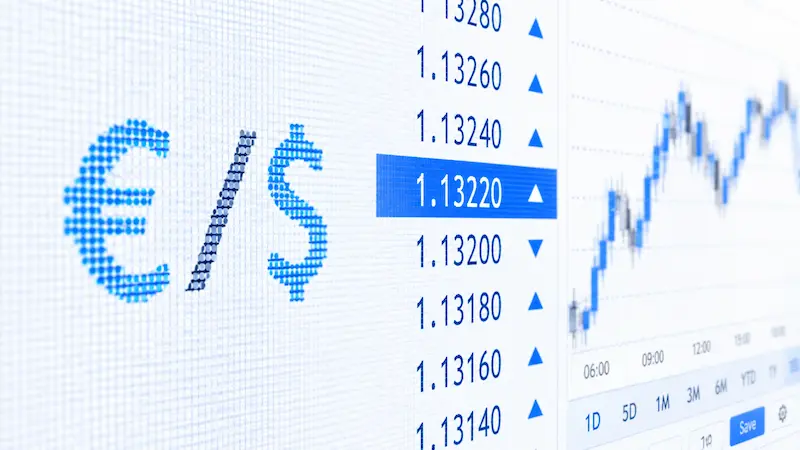
What Is a Pip in Forex? A Complete Beginner's Guide
Learn what a pip is, how to calculate pip value, and why it matters for every forex trader.
Read article
What Moves Gold Prices? The Complete Beginner's Guide
Understand the key drivers behind gold price movements — from inflation to central bank policy.
Read article
How Crypto Is Changing International Money Transfers
Discover how Bitcoin, USDT and XRP are making cross-border payments faster and cheaper.
Read articleStill have questions?
Can't find what you're looking for? Feel free to reach out to us.
Contact Support