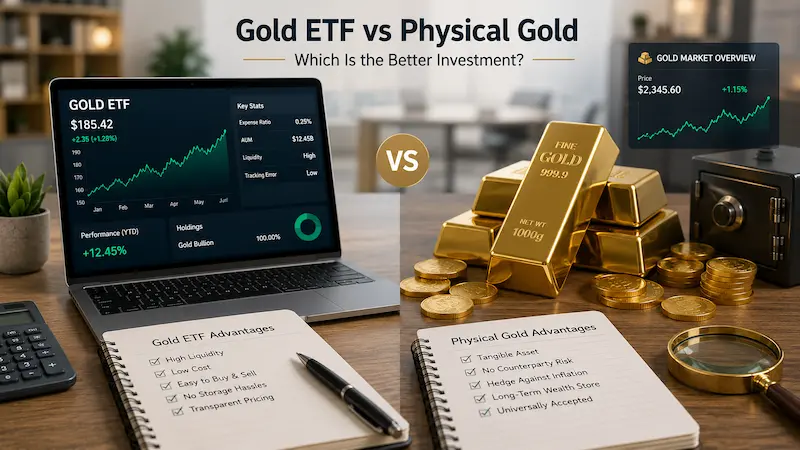

Gold is having its biggest moment in 50 years. The metal hit an all-time high of $5,589 per ounce in January 2026, central banks are buying record tonnes, and ordinary investors are asking the same question that has divided gold buyers for two decades: should I buy physical gold, or buy a gold ETF instead?
The answer is not as obvious as either camp pretends. Physical gold purists call ETFs "paper gold" with no real backing. ETF advocates call physical gold "an expensive hassle." The truth lies in understanding what each one actually does — and matching that to your specific goal.
This guide breaks down gold ETF vs physical gold across the six factors that actually matter: cost, liquidity, taxes, counterparty risk, storage, and real-world use cases. With current 2026 numbers.
Gold ETF vs Physical Gold — The Direct Answer
For most investors who want gold exposure as part of a diversified portfolio, a low-cost gold ETF like SPDR Gold MiniShares (GLDM) at 0.10% expense ratio is the more practical choice — lower transaction costs, instant liquidity, and full tax-advantaged account compatibility. Physical gold wins for investors prioritising no counterparty risk, generational wealth transfer, or geopolitical insurance — accepting higher purchase premiums (3–8%), storage requirements, and slower liquidation in exchange. The right answer depends on whether you want gold as an investment instrument or as a tangible asset.
What Is a Gold ETF?
A gold exchange-traded fund (ETF) is a security that holds physical gold bullion in vaults on behalf of investors. When you buy one share of a gold ETF, you own a fractional claim on the physical gold the fund holds — but you never take delivery of the metal yourself.
The major spot gold ETFs include SPDR Gold Shares (GLD) with over $80 billion in assets, iShares Gold Trust (IAU), SPDR Gold MiniShares (GLDM), and Aberdeen Standard Physical Gold Shares (SGOL). These funds hold physical gold bars in secure vaults — typically in London, New York, or Zurich — and track the spot gold price within fractions of a percent. You can monitor the live XAU/USD spot gold price in real time on FloatForex's gold charts page, updated every 2 minutes, alongside the current gold-to-silver ratio and a comparison of the major gold ETFs.
For investors completely new to ETF investing, see our complete guide on the best ETFs to buy in 2026 for context on how ETFs work across all categories before drilling into the gold-specific picks.
What Is Physical Gold?
Physical gold means owning actual metal — bars, coins, or jewellery — that you hold yourself or store in a private vault. The most common investment-grade forms are:
- Gold bars — typically 1 gram up to 1 kilogram, with the lowest premium over spot price for large sizes
- Sovereign coins — American Gold Eagle, Canadian Maple Leaf, Krugerrand, Austrian Philharmonic, Britannia, all 1 troy ounce
- Numismatic coins — collector coins where value comes from rarity, not just gold content (not recommended for pure investment)
- Allocated bullion accounts — physical gold stored in a vault on your behalf, with you holding legal title to specific bars
Physical gold has been a store of value for 5,000 years. ETFs have existed since 2003. That historical track record is the foundation of the "physical gold" argument.
Gold ETF vs Physical Gold — Side-by-Side Comparison
| Factor | Gold ETF (e.g. GLDM) | Physical Gold |
|---|---|---|
| Expense ratio / Premium | 0.10–0.40% annually | 3–8% premium over spot at purchase |
| Transaction speed | Instant during market hours | Days to weeks for delivery |
| Liquidity | Sell instantly via brokerage | Find dealer, get quote, ship/visit |
| Storage | None — held by custodian | Home safe or vault (annual cost) |
| Counterparty risk | Yes — fund and custodian | None — you hold the metal |
| Confiscation risk | Higher (institutional asset) | Lower (private holding) |
| Tax-advantaged accounts | Full compatibility (IRA, ISA) | Limited (only via specific gold IRAs) |
| Insurance | Included in expense ratio | You arrange separately |
| Minimum investment | One share (~$50–$200) | 1 gram (~$200) or 1 oz (~$5,000+) |
| Authenticity verification | Audited by fund | Your responsibility |
| Inheritance and transfer | Standard brokerage account transfer | Physical handoff or estate process |
| Geopolitical insurance value | Limited | High (portable, tangible) |
1. Cost — Where Each One Wins
Gold ETFs win on ongoing cost. The cheapest gold ETFs charge 0.10% per year (GLDM, IAU). On a $10,000 investment, that is $10 annually — almost nothing. Even the more expensive GLD at 0.40% costs only $40 per year.
Physical gold wins on long-term cost if you hold for decades. The initial premium is the catch. A 1 oz American Gold Eagle typically sells for 3–6% over spot, meaning if gold is at $5,500/oz, you pay $5,665–$5,830. Smaller bars and coins carry higher premiums (sometimes 8–15% for 1 gram pieces). However, once paid, there are no annual fees — meaning a 30-year hold pays no ongoing cost.
The break-even math: ETF at 0.10% costs about 3% over 30 years (ignoring compounding). Physical gold at a 5% premium pays itself back at the 50-year mark versus the cheapest ETFs. For holding periods under 20 years, ETFs are typically cheaper. For multi-generational wealth transfer, physical gold wins.
2. Liquidity — How Fast Can You Get Your Money?
This is where ETFs hold an enormous advantage that most physical gold buyers underestimate until they try to sell.
Gold ETFs sell instantly during market hours. Click "sell" in your brokerage app, the trade executes in seconds, and the cash settles in 1–2 business days. You receive the spot price minus a fractional spread.
Physical gold takes days to weeks to sell. You must find a buyer (local dealer, online dealer, pawnshop, private buyer), agree to a price (typically 1–3% below spot for bars, less for popular coins), ship or deliver the metal (insured shipping costs apply), wait for verification, and finally receive payment. In a market panic, premiums on physical gold often spike — meaning if you bought during a calm period and need to sell during a crisis, you may receive less than spot, even though spot prices may be rising.
3. Counterparty Risk — The Core Argument for Physical
This is the strongest argument for physical gold ownership — and the most overstated.
The case against ETFs: When you own a gold ETF, you do not own gold. You own a share of a trust that owns gold. If the custodian fails, if the fund is sanctioned, if there is fraud in the audit process, or if a government nationalises the trust's holdings, your exposure is to those institutional risks — not just the gold price.
The case for ETFs: Major gold ETFs are audited multiple times per year. GLD's holdings are audited by Inspectorate International. The trust structure makes the gold property of shareholders, not the fund manager. The custodians (HSBC for GLD, JPMorgan for IAU) are major regulated banks. The probability of total loss is extremely low.
The honest assessment: Counterparty risk on major gold ETFs is real but small. Counterparty risk on small ETFs from obscure issuers is meaningfully higher. If counterparty risk concerns you genuinely (post-2022 Russia sanctions changed how many investors think about this), physical gold is the only true zero-counterparty option.
4. Tax Treatment — A Key US Investor Consideration
For US investors, this is one of the most important factors and one most buyers do not know.
Gold ETFs are taxed as collectibles in the US. Even though they are stocks, the IRS classifies physical gold ETFs (GLD, IAU, GLDM, SGOL) as collectibles. This means long-term capital gains are taxed at a maximum 28% rate — higher than the 15–20% applied to regular stock ETFs.
Physical gold is also taxed as a collectible at the same 28% maximum rate. So at the federal capital gains level, ETFs and physical gold are treated identically in the US.
Where ETFs win on tax: Gold ETFs can be held in tax-advantaged accounts (Traditional IRA, Roth IRA, 401(k)) with full normal treatment. Physical gold can only be held in a specialised "gold IRA" with extra custodian fees and storage requirements. For long-term retirement gold exposure in tax-advantaged accounts, ETFs are dramatically simpler.
In the UK, gold sovereign coins (Britannia, Sovereign) are exempt from capital gains tax entirely — a significant advantage for UK investors that no ETF can match. Tax treatment varies by country, so always confirm local rules before deciding.
5. Storage and Security
Gold ETFs have no storage problem. The custodian handles physical security, insurance, and auditing. You pay nothing additional beyond the expense ratio.
Physical gold requires a storage decision. The three options:
- Home safe — convenient but invites theft risk and requires a homeowner's insurance rider
- Bank safe deposit box — affordable ($50–$200/year) but not insured by FDIC and inaccessible during bank holidays
- Private vault (Brinks, Loomis, Singapore Freeport, etc.) — fully insured, allocated storage, but costs 0.5–1% of gold value annually plus annual fees
For $10,000 in physical gold, private vault storage can cost $50–$200/year — already matching the ETF expense ratio. For amounts under $5,000, home or bank storage tends to make more sense.
6. Which Should You Choose? — 6 Real-World Scenarios
Scenario 1 — You want gold as portfolio diversification (5–10% allocation)
Winner: Gold ETF (GLDM or IAU). Low cost, instant rebalancing, no storage hassle, tax-advantaged account compatibility. The classic 5% gold allocation strategy fits naturally in a brokerage IRA via a gold ETF.
Scenario 2 — You want geopolitical insurance / hedge against currency collapse
Winner: Physical gold. An ETF held in a brokerage account is subject to the same financial system risks you are trying to hedge against. Physical gold in a private vault — or buried in your backyard — is the only genuine insurance policy against institutional failure.
Scenario 3 — You are passing wealth to children/grandchildren over 30+ years
Winner: Physical gold. No expense ratio compounding against you. Tangible, transferable, and culturally meaningful across generations. Particularly common in South Asian and Middle Eastern families.
Scenario 4 — You trade gold actively based on macro signals
Winner: Gold ETF. Instant entry and exit. Real-time pricing. Position sizing in $100 increments. Stop-loss orders. None of this is possible with physical metal.
Scenario 5 — You are an NRI in the UAE buying gold for the long term
Winner: Physical gold (with caveats). The UAE has zero VAT on investment-grade gold (99.5%+ purity), the Dubai Gold Souk is one of the most competitive physical gold markets globally, and physical gold travels well for Indian family transfers, within India's customs allowance. The AED is pegged to USD at 3.6725, so currency risk on the AED side is minimal — see our analysis on why the UAE Dirham is pegged to the US Dollar.
Scenario 6 — You have less than $2,000 to invest in gold
Winner: Gold ETF. Physical gold premiums on small purchases are punishing — sometimes 15%+ on 1-gram bars. A $200 ETF position gets you near-perfect spot exposure. Physical gold makes economic sense above approximately $5,000 in single purchases where premiums drop below 5%.
The 4 Best Gold ETFs in 2026 — Quick Comparison
| ETF | Ticker | Expense Ratio | AUM | Best For |
|---|---|---|---|---|
| SPDR Gold MiniShares | GLDM | 0.10% | $8B+ | Cost-conscious long-term holders |
| iShares Gold Trust | IAU | 0.25% | $30B+ | Balance of cost and liquidity |
| Aberdeen Physical Gold | SGOL | 0.17% | $3B+ | Swiss-vaulted preference |
| SPDR Gold Shares | GLD | 0.40% | $80B+ | Maximum liquidity for active traders |
For most long-term investors, GLDM offers the best combination of low cost (matching ETF leaders like VOO at 0.10%) and adequate liquidity. Active traders may prefer GLD for tighter spreads despite the higher expense ratio.
The Best Physical Gold to Buy
If physical is your choice, stick to widely-recognised, low-premium products to maintain resale value:
- 1 oz sovereign coins — American Gold Eagle, Canadian Maple Leaf, Austrian Philharmonic, Britannia, Krugerrand. Universally recognised, easy to sell, premiums of 3–6% over spot
- Cast gold bars 100g and 1kg — PAMP Suisse, Valcambi, Perth Mint, Argor-Heraeus. Lowest premiums per gram, but harder to liquidate in small amounts
- Avoid: numismatic/collector coins (premiums based on rarity, not gold), private mint bars without recognised hallmarks, jewellery for investment purposes (huge markup: see how making charges and GST add up), gold-plated items
The Hybrid Approach — What Most Sophisticated Investors Actually Do
The choice does not have to be binary. Many experienced gold investors hold both:
- 70–80% in gold ETFs — for cost-efficient core exposure, easy rebalancing, and tax-advantaged account placement
- 20–30% in physical gold — as true insurance against institutional risk, currency collapse, or asset confiscation
This approach gets the benefits of both — low ongoing cost on the bulk of your gold allocation, with genuine counterparty-free insurance for the worst-case scenarios that drove you to gold in the first place. Combine with consistent buying — see our guide to dollar-cost averaging — to smooth out entry timing.
Frequently Asked Questions — Gold ETF vs Physical Gold
Is a gold ETF as good as owning physical gold?
For most investment purposes — portfolio diversification, inflation hedging, capital appreciation — a low-cost gold ETF tracks the gold price nearly identically to physical gold while offering dramatically better liquidity, lower transaction costs, and tax-advantaged account compatibility. For pure insurance against systemic financial risk or generational wealth transfer, physical gold has advantages an ETF cannot match. The right answer depends on which job you want gold to do.
Which gold ETF is the cheapest?
SPDR Gold MiniShares (GLDM) at 0.10% and iShares Gold Trust (IAU) at 0.25% are the cheapest major gold ETFs. GLDM is the lowest-cost option at the same expense ratio as flagship equity ETFs like Vanguard's VOO. The better-known SPDR Gold Shares (GLD) at 0.40% costs four times as much — its only advantage being higher daily trading volume for active traders needing tighter spreads.
Does a gold ETF actually own physical gold?
Yes — the major spot gold ETFs (GLD, IAU, GLDM, SGOL) are physically backed, meaning they hold actual gold bars in secure vaults on behalf of shareholders. GLD and GLDM hold gold with HSBC custodians. IAU holds gold with JPMorgan. These holdings are audited multiple times per year. Shareholders technically own a fractional claim on the underlying physical gold, though most retail investors cannot redeem ETF shares for physical metal directly.
Can I lose money in a gold ETF?
Yes. Gold ETFs track the gold price, so if gold falls, your investment falls. Gold dropped over 25 percent from its January 2026 all-time high of $5,589 within weeks before stabilising. ETFs do not protect against price declines — they replicate them. For the full outlook on gold prices, see our Gold Price Forecast 2026.
How is gold taxed in the US — ETF vs physical?
Both gold ETFs and physical gold are classified as collectibles by the IRS in the US, subject to a maximum 28 percent long-term capital gains tax rate — higher than the 15–20 percent applied to stocks. The main tax advantage of gold ETFs is account compatibility: they can be held in any IRA or 401(k) with no special structure. Physical gold can only be held in a specialised gold IRA with extra custodian and storage requirements. Tax rules vary significantly by country.
What is the best way to buy gold in the UAE or Dubai?
The UAE has no VAT on investment-grade gold (99.5%+ purity), and Dubai's Gold Souk is one of the most competitive physical gold markets globally. UAE residents have unique advantages — combining low purchase premiums with the AED's stable peg to the USD at 3.6725. For most UAE investors, physical gold from established Souk dealers, DMCC-licensed traders, or major banks offers an excellent balance of low premium and security.
Should I sell my physical gold and buy a gold ETF?
Not necessarily. If you already own physical gold, selling triggers a taxable event (collectibles rate up to 28 percent in the US) plus you lose 1–3 percent on the resale spread. Unless your situation has fundamentally changed — for example, you no longer need geopolitical insurance, or you want to place gold in a retirement account — the friction of switching usually outweighs the small ongoing expense ratio savings. The conversion makes sense only for very large physical holdings (over $50,000) being actively traded.
What is the safest way to store physical gold?
For amounts under $5,000, a quality home safe with a homeowner's insurance rider is typically sufficient. For $5,000–$50,000, a bank safe deposit box (low cost but uninsured) or a private vault service like Brinks or Loomis offers a balance of security and cost. For amounts above $50,000, allocated storage in a recognised vault facility (Singapore Freeport, Swiss vaults, BullionVault) with full insurance is standard. Never store all your gold in one location.
The Bottom Line
The gold ETF vs physical gold debate is not really about which is "better" — it is about which is better for what you specifically want gold to do. Gold ETFs are the more efficient investment instrument: lower costs, instant liquidity, retirement account compatible, and operationally simple. Physical gold is the more durable store of value: zero counterparty risk, no expense ratios, geopolitically portable, and culturally meaningful across generations.
The sophisticated investor's answer is usually "both" — the bulk in a low-cost ETF like GLDM for everyday gold exposure, plus a smaller physical allocation as true insurance against the scenarios that ETFs cannot hedge. Whatever you choose, gold's role in a diversified portfolio remains compelling in 2026 — and choosing the right vehicle for that exposure is as important as the decision to own gold in the first place.
Related FloatForex guides:
Best ETFs to Buy in 2026 — Top 10 by Category |
Gold Price Forecast 2026 — Will XAU/USD Hit $5,000, $6,000 or Higher? |
Silver Surged 148% in 2025 |
What Moves Gold Prices — Complete Guide |
Dollar-Cost Averaging Explained |
Live XAU/USD Gold Price Chart
Note: This article is for informational and educational purposes only and does not constitute financial or investment advice. Gold prices are volatile and tax treatment varies by jurisdiction. Always consult a qualified financial advisor before making investment decisions.