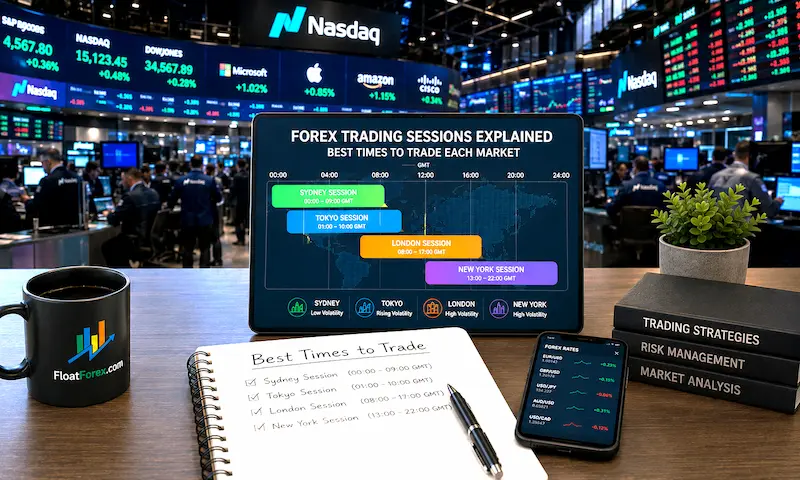

The forex market never sleeps — but it doesn't behave the same way at 3 am as it does at 3 pm. Trading volume, volatility, and spreads change dramatically depending on which financial centres are open. Understanding forex trading sessions is one of the most underrated skills in trading: the same strategy can be profitable during the London session and consistently lose money in the quiet hours after New York closes.
This guide explains the four major trading sessions, when each market opens and closes, which sessions overlap, and how to use live forex market hours to time your trades for maximum liquidity and opportunity.
What Are Forex Trading Sessions?
Unlike a stock exchange, the foreign exchange market has no central location. It is a decentralized global network of banks, institutions, and brokers. Trading activity follows the business day around the planet through four major financial centres: Sydney, Tokyo, London, and New York. As one centre winds down, the next is already opening — which is why forex trades continuously from Sunday evening to Friday evening (22:00 UTC to 22:00 UTC).
Each of these windows is called a trading session. While currencies technically trade during all sessions, the volume behind each pair shifts depending on which region is awake. The Japanese yen is most active during Tokyo hours; the British pound moves most during London hours. Knowing this rhythm is the foundation of session-based trading.
The Four Major Forex Trading Sessions
| Session | Hours (UTC) | Approx. Volume Share | Most Active Pairs |
|---|---|---|---|
| Sydney | 22:00 – 07:00 | ~4% | AUD/USD, NZD/USD, AUD/JPY |
| Tokyo | 00:00 – 09:00 | ~6% | USD/JPY, EUR/JPY, AUD/JPY |
| London | 08:00 – 17:00 | ~38% | EUR/USD, GBP/USD, EUR/GBP |
| New York | 13:00 – 22:00 | ~17% | EUR/USD, USD/CAD, USD/JPY |
Note: session times shift by one hour when regions enter or exit daylight saving time. Our forex market hours clock converts all session times to your local timezone automatically.
Sydney Session (22:00 – 07:00 UTC)
The Sydney session opens the trading week. It is the smallest of the four sessions by volume, but it plays an important role: after the weekend, price gaps and early positioning happen here. Liquidity is thin, spreads are wider, and moves are usually modest — except on Monday openings after weekend news, when gaps can be significant.
Best suited for: AUD and NZD pairs, gap-trading strategies, and quiet range trading. Aggressive breakout strategies generally underperform in this session.
Tokyo Session (00:00 – 09:00 UTC)
Tokyo is the heart of Asian trading and the first session with meaningful institutional volume. The Bank of Japan, Japanese exporters, and regional funds drive flows in yen pairs. Price action tends to be steadier and more range-bound than in Western sessions — many traders use the "Asian range" (the high and low set during Tokyo hours) as reference levels for breakout trades later in the day.
Best suited for: USD/JPY, EUR/JPY, and cross-yen pairs; range strategies; and marking support/resistance levels that London traders will later test.
London Session (08:00 – 17:00 UTC)
London is the largest forex trading centre in the world, handling roughly 38% of global volume. When London opens, spreads compress, liquidity deepens, and the day's dominant trends often begin. The first two hours of the London session are among the most volatile of the entire day, as European institutions execute overnight orders and react to the Asian session.
Best suited for: EUR/USD, GBP/USD, EUR/GBP, and essentially every major pair. Momentum and breakout strategies perform best here — particularly the classic "London open breakout" of the Asian range.
New York Session (13:00 – 22:00 UTC)
The New York session brings US economic data — non-farm payrolls, CPI, Fed decisions — and deep dollar liquidity. The first four hours overlap with London and represent the most active window in the market. After London closes at 17:00 UTC, volume drops sharply; the late New York afternoon is one of the quietest periods of the day, and spreads widen accordingly.
Best suited for: news trading around US data releases, USD pairs, and trend continuation from the London session. Avoid initiating new positions in the final hours before the daily close, when liquidity evaporates.
Session Overlaps: Where the Real Action Happens
The most important concept in forex market hours is the overlap — periods when two major sessions are open simultaneously. Liquidity from both regions stacks, producing tighter spreads and larger moves.
London–New York Overlap (13:00 – 17:00 UTC)
This is the golden window of forex trading. More than half of all daily volume flows during these four hours. Both of the world's largest trading centres are active, US economic data is typically released at 13:30 UTC, and institutional order flow peaks. If you can only trade four hours a day, these are the four hours to choose — especially for EUR/USD, GBP/USD, and USD/JPY.
Tokyo–London Overlap (08:00 – 09:00 UTC)
A brief but meaningful handover hour. Asian liquidity passes to Europe, and breakouts from the overnight Asian range frequently occur here. Many London-open strategies are built entirely around this single hour.
Sydney–Tokyo Overlap (00:00 – 07:00 UTC)
The two Asia-Pacific sessions run largely in parallel. Combined liquidity is still modest compared to European hours, but AUD, NZD, and JPY pairs see their best conditions of the day during this window.
Forex Volatility by Session: When Do Markets Move Most?
Volatility follows a predictable daily pattern that repeats with remarkable consistency:
- Lowest volatility: the hours after New York closes and before Tokyo fully activates (22:00 – 00:00 UTC). Spreads are at their widest; many algorithmic systems switch off entirely.
- Rising volatility: through the Tokyo session, as Asian institutions trade yen and Pacific currencies.
- First peak: the London open (08:00 – 10:00 UTC), when European volume floods in and the day's trend often establishes itself.
- Maximum volatility: the London–New York overlap (13:00 – 17:00 UTC), amplified by US economic data.
- Sharp decline: after London closes at 17:00 UTC, activity fades steadily into the daily close.
Each currency pair has its own volatility signature within this pattern. GBP/USD moves most during London hours; USD/JPY is comparatively more active during Tokyo hours than other majors; AUD/USD sees its relative peak during Sydney–Tokyo hours. Matching your pair to its most active session is one of the simplest edges available to a retail trader.
How to Trade Each Session: Practical Strategies
The Asian Range Breakout
Mark the high and low of the Tokyo session, then trade the breakout when London opens. This classic strategy exploits the transition from Asia's range-bound behaviour to Europe's directional momentum. It works because the same institutional flows repeat daily: European desks act on overnight information at the open, resolving the Asian consolidation in one direction.
London Open Momentum
The first 1–2 hours of London (08:00 – 10:00 UTC) frequently set the direction for the European morning. Momentum traders enter in the direction of the initial impulse, with stops beyond the pre-open range. This approach requires fast execution and disciplined stops — the same volatility that creates the opportunity can produce sharp reversals.
News Trading in the New York Session
Major US releases — non-farm payrolls, CPI, FOMC decisions — land during the London–New York overlap and can move majors 50–150 pips in minutes. News traders either position before the release based on expectations, or trade the post-release momentum once direction is confirmed. Check an economic calendar every morning; trading blind through a Fed decision is how accounts get destroyed.
Avoiding the Dead Zone
Perhaps the most valuable session knowledge is knowing when not to trade. The window between the New York close and the Tokyo open combines the day's widest spreads with its thinnest liquidity. Stop hunts and erratic spikes are common. Most consistently profitable retail traders simply stay out of this window.
Common Mistakes with Forex Market Hours
- Ignoring daylight saving time. Session times in UTC shift twice a year when the US, UK, and Australia change their clocks. A strategy timed to "8:00 my time" can silently drift an hour off its intended session. Use a live market hours clock that adjusts automatically rather than memorised times.
- Trading every session the same way. A breakout strategy calibrated on London data will bleed slowly in Tokyo conditions. Test strategies against the session you actually intend to trade.
- Confusing "market open" with "market active". The forex market being technically open 24/5 doesn't mean conditions are tradeable 24/5. Liquidity — not the clock — is what makes a market tradeable.
- Overtrading the overlap. High volatility cuts both ways. The London–New York window offers the biggest moves and the fastest losses. Position sizing matters more here, not less.
Frequently Asked Questions
What time does the forex market open?
The forex market opens Sunday at 22:00 UTC with the Sydney session and runs continuously until Friday 22:00 UTC when New York closes. During the trading week there is always at least one major session open.
What is the best time to trade forex?
For most traders and most major pairs, the London–New York overlap (13:00 – 17:00 UTC) offers the best combination of liquidity, tight spreads, and meaningful price movement. Traders focused on JPY, AUD, or NZD pairs may prefer the Tokyo session, when those currencies are most active.
Which forex session is most volatile?
The London session produces the most volatility overall, and volatility peaks during its overlap with New York. The London open (08:00 UTC) and the US data window (13:30 UTC) are the two most explosive moments of a typical trading day.
Can I trade forex at night?
You can — the market is open — but conditions depend on your timezone. "Night" in Europe corresponds to the quieter Sydney/Tokyo sessions, where spreads are wider on EUR and GBP pairs but Asian pairs trade normally. Match your pair choice to whichever session your schedule allows.
Do session times change during the year?
Yes. Because sessions follow local business hours, UTC session times shift by one hour when the US, UK, or Australia enter or exit daylight saving time. The relative structure of the day — Asian range, London impulse, overlap peak — remains the same year-round.
Track the Sessions Live
Reading about sessions is one thing; seeing them in real time is another. Our free Forex Market Hours clock shows all four trading sessions converted to your local timezone, with live open/closed status and the London–New York overlap highlighted — so you always know exactly which markets are active before you place a trade. Pair it with our forex heatmap to see which currencies are moving right now, and check live rates for the majors like EUR/USD, GBP/USD and USD/JPY.
The market rewards traders who show up at the right time. Session knowledge won't pick your trades for you — but it will make sure the market is actually awake when you place them.