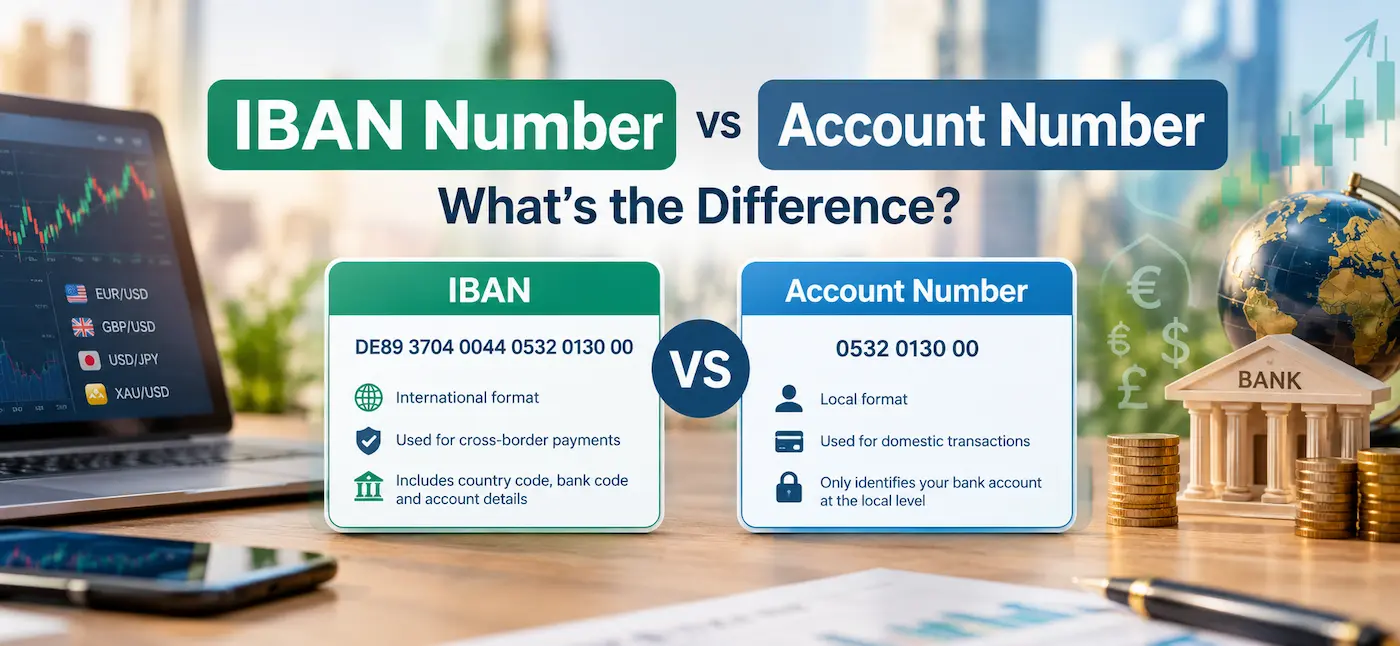

If you've ever been asked for your IBAN and reached for your account number instead, you're not alone. The two are closely related, but they aren't interchangeable. Your account number identifies your account inside your own bank. Your IBAN wraps that same account number in an international format that any bank in the IBAN system can check and route.
This guide explains exactly how the two differ, shows how an account number becomes an IBAN in four real formats, and covers what to use instead in countries that don't use IBANs at all, including the United States and India.
🔑 Quick answer: No, an IBAN is not the same as your account number. The IBAN contains your account number, plus a country code, two check digits and usually a bank code. Use your IBAN for SEPA and most international payments; use your domestic account details where your country still relies on them, such as for payments within the UK.
What Is an Account Number?
An account number is the identifier your bank uses for your account within its own system. Its format is set nationally, so it varies a lot from country to country. A UK account number is 8 digits and is always used together with a 6-digit sort code. A German account number can be up to 10 digits and sits alongside an 8-digit bank code, the Bankleitzahl. In India, account numbers can run from 9 to 18 digits.
On its own, an account number only makes sense inside its home country. A bank abroad has no reliable way to tell which bank it belongs to, and no standard way to check whether a digit has been mistyped.
What Is an IBAN Number?
IBAN stands for International Bank Account Number, so "IBAN number" is technically repetitive, but it's how most people search for it and it means exactly the same thing. An IBAN can be up to 34 characters long and is always built from three parts:
- 🌍 Country code — two letters from the ISO 3166-1 standard, such as DE for Germany or AE for the UAE
- 🔢 Check digits — two numbers that let any bank detect typos before money moves
- 🏦 BBAN (Basic Bank Account Number) — your bank code and account number, in your country's own format
In other words, your account number is already inside your IBAN. The IBAN simply adds the country and the check digits, and packages everything in a structure every participating bank understands. For a full introduction to the format, see our guide What Is an IBAN?
IBAN vs Account Number: The Key Differences
| Feature | Account number | IBAN |
|---|---|---|
| Scope | Domestic only | International — used in more than 80 countries |
| Format | Set by each country, with no common standard | ISO 13616: country code + check digits + BBAN |
| Length | Varies widely (8 digits in the UK, up to 18 in India) | Fixed per country, from 15 to 34 characters |
| Typo detection | Depends on the country — some formats have a check digit, many don't | Always — the MOD-97 check digits catch almost every typo |
| Identifies the bank | Only together with a separate code, such as a sort code or bank code | Yes — the bank code is built into the IBAN |
| Typical use | Domestic payments in countries without IBAN, and within the UK | SEPA payments and most international transfers |
How Your Account Number Becomes an IBAN
Your IBAN isn't a second account. It's your existing account details in an international wrapper. Here's how a German bank builds an IBAN from a bank code and an account number, step by step:
1️⃣ Start with the domestic details. Bank code 37040044 and account number 0532013000, padded with leading zeros to the full 10 digits.
2️⃣ Join them into the BBAN. Together they form the domestic part of the IBAN: 370400440532013000.
3️⃣ Calculate the check digits. The bank adds the country code as numbers (D = 13, E = 14) plus two zeros to the end, giving 370400440532013000131400. It divides that by 97, which leaves a remainder of 9, and subtracts the remainder from 98. The check digits are 89.
4️⃣ Put it together. Country code, check digits and BBAN in that order: DE89 3704 0044 0532 0130 00. The spaces are only there for readability; electronically it's written as one string.
⚠️ Don't build your own IBAN to make a payment. The check digits only prove the number is internally consistent. A single wrong digit in the bank code or account number produces a different IBAN that still passes validation, because the check digits are calculated from whatever you typed. Always copy your IBAN from your bank's app or statement, then run an IBAN check before you share it.
Account Number to IBAN: Four Real Examples
Every country packs its domestic details into the BBAN differently. These examples show how familiar account details map onto an IBAN:
| Country | Domestic details inside the IBAN | Example IBAN | Length |
|---|---|---|---|
| 🇩🇪 Germany | 8-digit bank code + 10-digit account number | DE89 3704 0044 0532 0130 00 | 22 |
| 🇬🇧 United Kingdom | 4-letter bank code + 6-digit sort code + 8-digit account number | GB29 NWBK 6016 1331 9268 19 | 22 |
| 🇦🇪 United Arab Emirates | 3-digit bank code + 16-digit account number | AE07 0331 2345 6789 0123 456 | 23 |
| 🇵🇰 Pakistan | 4-letter bank code + 16-digit account number | PK36 SCBL 0000 0011 2345 6702 | 24 |
These are format examples widely used in banking documentation, not real accounts, so never send money to them. You'll find more in the IBAN examples by country table on our IBAN validator page, where each one can be checked in a single click.
Notice the UK row: the sort code and account number are both visible inside the IBAN. That's why people in the UK still use their sort code and account number for payments within the UK, and only need the IBAN when money is coming from abroad.
Which One Should You Use?
- 🇪🇺 Euro payments within SEPA: use the IBAN. Since the SEPA migration in 2014, euro-area countries use the IBAN even for domestic transfers, and since 2016 banks have not been allowed to require a BIC for SEPA payments. For euro payments, an account located in one EU country must be accepted in any other — a company that refuses yours because of its country code may be breaking EU law, as our guide to IBAN discrimination explains.
- 🌐 International transfers outside SEPA: use the IBAN plus a SWIFT/BIC code. If the recipient's country uses IBAN, the IBAN identifies the account and the BIC identifies the bank. You can confirm a bank code's format with our SWIFT/BIC lookup.
- 🏠 Domestic payments in countries like the UK: use your local details. Sort code and account number remain the standard for payments within the UK.
Is There an IBAN Equivalent in the USA?
No. The United States doesn't use IBANs, and neither do Canada, Australia, India or China. Each relies on its own domestic system to identify the bank, alongside the account number:
| Country | What's used instead of an IBAN | Format of the bank code |
|---|---|---|
| 🇺🇸 United States | ABA routing number + account number | 9 digits |
| 🇨🇦 Canada | Transit number + institution number + account number | 5-digit transit, 3-digit institution |
| 🇦🇺 Australia | BSB + account number | 6 digits |
| 🇮🇳 India | IFSC + account number | 11 characters |
| 🇨🇳 China | CNAPS code + account number | 12 digits |
For international transfers into these countries, you'll normally need the bank's SWIFT/BIC code and the recipient's account number, and sometimes the domestic code as well, such as the IFSC for payments to India. If someone abroad asks for your IBAN and you bank in one of these countries, give them your bank's SWIFT code and your account number instead.
Common Mix-Ups That Cause Failed Payments
- ❌ Giving your account number when asked for an IBAN. A domestic account number fails IBAN validation immediately. Using a domestic number in place of the full IBAN is one of the main reasons international transfers get rejected.
- ❌ Confusing the IBAN with the SWIFT/BIC code. The BIC is 8 or 11 characters and identifies the bank; the IBAN is 15 to 34 characters and identifies the account.
- ❌ Using your card number. The long number on the front of your debit card is your card number, not your IBAN. Some banks print the IBAN on the back of the card, but it's a different number.
- ❌ Assuming a valid IBAN is the right IBAN. A successful IBAN check confirms the format, not the owner. If money has already gone to the wrong account, see what happens if you send money to the wrong IBAN.
- ✅ The fix: copy the IBAN straight from the bank's app or statement, run it through an IBAN validator, and confirm the recipient's name before you pay.
How to Check an IBAN Before You Send
An IBAN validator confirms three things in seconds: the country code is recognised, the length matches that country's standard, and the check digits pass the MOD-97 test. Our free IBAN checker also splits the IBAN into its country code, check digits and BBAN, so you can compare the BBAN with the domestic details you were given — a quick way to spot a mismatch between an invoice and the IBAN printed on it.
For euro transfers sent from a bank in a euro-area country, there's now a second layer of protection. Since October 2025, your bank compares the recipient's name with the account holder's name before you confirm the payment and warns you if they don't match. It's a warning rather than a block, so treat a "no match" result as a reason to stop and check.
Frequently Asked Questions
Is IBAN the same as account number?
No. Your IBAN contains your account number, but it adds a country code, two check digits and usually a bank code. The account number works only within its own country; the IBAN works across every country that uses the IBAN standard.
Is an "IBAN number" the same as an IBAN?
Yes. IBAN already stands for International Bank Account Number, so "IBAN number" repeats the word number. Both terms refer to exactly the same thing.
How do I convert my account number to an IBAN?
The safest way is not to convert it yourself. Your bank shows your IBAN in its mobile app, in online banking under account details, and on your statements. If you can't find it, your bank can give it to you directly. Once you have it, run it through an IBAN validator to confirm the format.
Does the US have IBAN numbers?
No. US banks use a 9-digit ABA routing number together with your account number. To receive money from abroad into a US account, the sender usually needs your bank's SWIFT code and your account number.
Can I receive international payments with just my account number?
It depends on where your account is. In countries without IBAN, such as the US or India, international senders use your account number plus your bank's SWIFT code. In IBAN countries, senders abroad will almost always need your full IBAN.
Where can I find my IBAN?
Look in your banking app or online banking under account details, on your bank statements, or on the welcome letter for your account. Some banks also print it on the back of your debit card. Our IBAN validator page explains each option in more detail.
Final Thoughts
Your account number and your IBAN describe the same account, just at two different scales: one for your own country, one for the international banking system. Once you see the account number sitting inside the IBAN, the difference is easy to remember, and so is the rule for using them: IBAN for SEPA and most international payments, local details where your country still relies on them.
Before you share or pay to an IBAN, take a few seconds to run an IBAN check with our free IBAN checker, confirm the bank with our SWIFT/BIC lookup, and look up any country's code in our country codes directory.
For related reading, see our guides What Is an IBAN?, Why Was My International Transfer Rejected?, What Happens If You Send Money to the Wrong IBAN? and IBAN Discrimination: Your Right to Use Any EU Bank Account.
Disclaimer: This article is for informational purposes only and does not constitute financial advice. Exchange rates and market conditions change rapidly. Always conduct your own research before making any investment decisions.