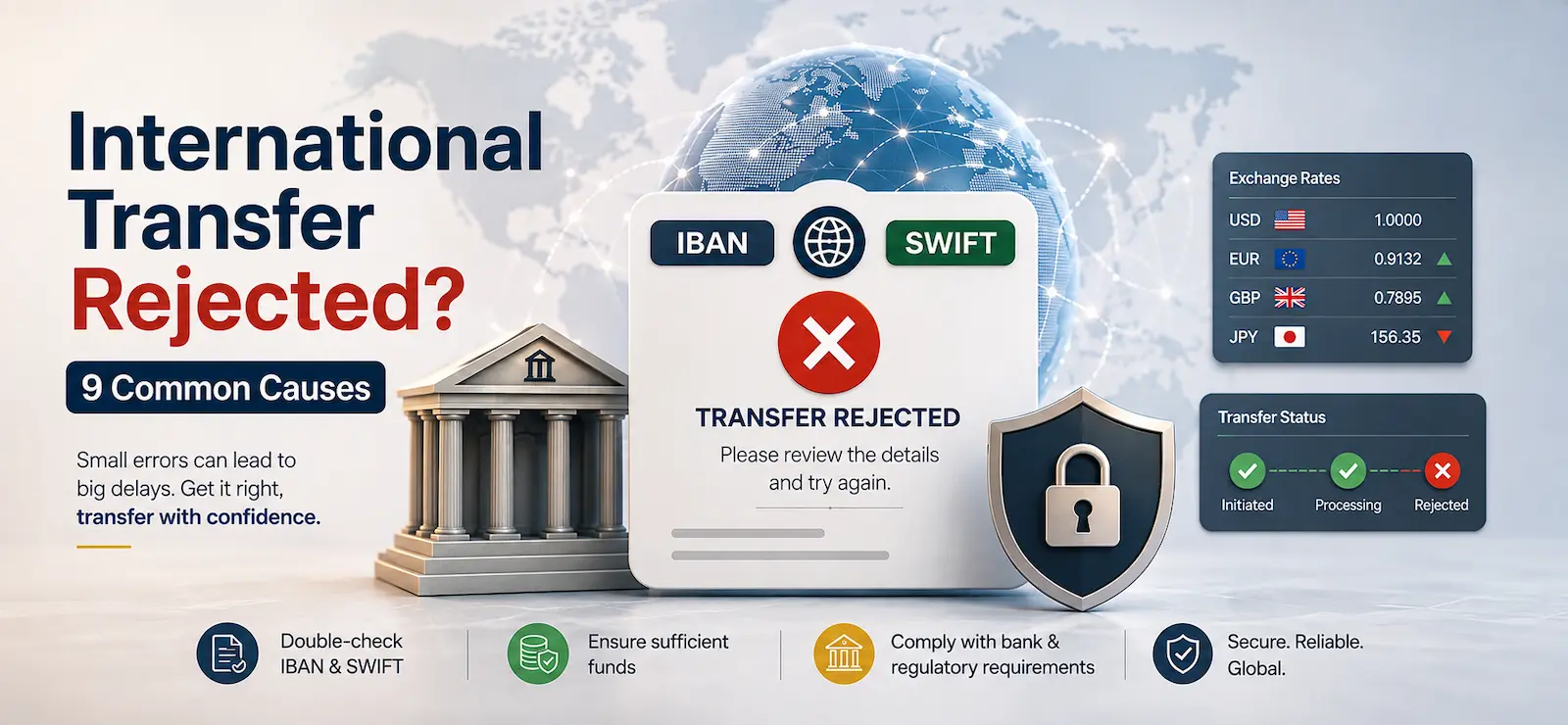

An international transfer is usually rejected for a technical or compliance reason, not because your bank refused to send it. The most frequent causes are an invalid IBAN, a wrong or missing SWIFT/BIC code, and a mismatch between the beneficiary name and the account details. In most cases the money is returned to your account within a few working days, minus any fees already charged.
Below are the nine causes that account for the large majority of failed cross-border payments, what each one actually means, and how to fix it before you resend.
Quick reference: which cause is yours?
| What your bank told you | Likely cause |
|---|---|
| "Invalid account number" / "IBAN check failed" | Cause 1 — IBAN error |
| "Bank not found" / "Invalid BIC" | Cause 2 — SWIFT/BIC problem |
| "Beneficiary details do not match" | Cause 3 — name mismatch |
| "Account closed" / "Account blocked" | Cause 4 — account status |
| "Currency not accepted" | Cause 5 — currency mismatch |
| "Missing information" / "Purpose of payment required" | Cause 6 — incomplete reference |
| Payment held, then returned days later | Cause 7 — compliance screening |
| Returned by a bank you have never heard of | Cause 8 — intermediary bank |
| "Limit exceeded" / "Insufficient funds" | Cause 9 — limits and funding |
1. The IBAN is invalid or mistyped
This is the single most common cause of a rejected transfer. An IBAN contains two check digits that validate the entire number mathematically, using the ISO 7064 MOD-97 algorithm. If a single character is wrong, the check fails and the payment is stopped before it ever leaves your bank.
Typical errors include a missing or extra digit, confusing the letter O with the digit 0, confusing the letter I with the digit 1, and using a domestic account number instead of the full IBAN. Length is also fixed per country — a German IBAN is 22 characters, a French IBAN is 27, and a UAE IBAN is 23 — so a number of the wrong length is rejected immediately.
How to fix it: validate the number before resending. Our free IBAN checker confirms the length, country code and MOD-97 check digits in one step, and shows which country the number belongs to along with its check digits and domestic account part (the BBAN).
A valid IBAN confirms the number is correctly formed. It does not confirm the account is open or that it belongs to the person you intend to pay — only the receiving bank can verify that.
2. The SWIFT/BIC code is wrong or missing
An IBAN identifies the account. A SWIFT/BIC code identifies the bank. Transfers outside SEPA and most non-euro payments need both: the BIC routes the payment to the correct institution, and the IBAN directs it to the correct account inside that institution. For euro payments within SEPA the IBAN alone is enough — banks haven't been allowed to require a BIC for SEPA payments since 2016 — so this cause mainly affects payments outside that area.
Problems arise when the BIC belongs to a different branch, when an 8-character code is supplied where an 11-character branch code is required, or when the BIC and IBAN point to two different banks entirely. Banks reject rather than guess.
How to fix it: confirm the code with our SWIFT/BIC checker, and make sure the bank it identifies matches the bank named on the invoice or payment request.
3. The beneficiary name does not match the account
Banks increasingly check the account holder's name against the account. Since 9 October 2025, payment providers in euro-area countries must run a Verification of Payee check on euro credit transfers before you confirm them. You'll see a match, a close match (with the correct name shown), a no match, or a message that the check wasn't possible. A close or no match is a warning, not a block — you can still send, but you generally bear the risk if you do. Providers in EU countries outside the euro area must offer the check by 9 July 2027. Separately, some receiving banks — particularly outside SEPA — return a payment when the name doesn't match their records.
Common triggers are using a trading name instead of the registered legal entity, abbreviating a company name, transposing first and last names, and omitting accented characters.
How to fix it: use the exact account holder name as it appears on the recipient's bank records — not the name on their invoice letterhead, and not a shortened version.
4. The account is closed, dormant or blocked
A structurally valid IBAN can point to an account that no longer accepts payments. Accounts are closed when customers move banks, marked dormant after long inactivity, or frozen during a compliance review or legal dispute.
This cause is impossible to detect in advance from the account details alone, which is why funds are usually returned only after the receiving bank has attempted to credit the account.
How to fix it: contact the recipient and request current details. If they recently changed banks, ask specifically whether the old account has been closed.
5. The receiving account does not accept that currency
Not every account can receive every currency. A euro-only account may reject an incoming US dollar payment, and some accounts accept foreign currency but convert it automatically at a rate the recipient did not choose.
This causes two distinct problems: outright rejection, or acceptance at an unfavourable conversion. The second is more expensive and far less visible, because the payment appears to have succeeded.
How to fix it: confirm which currency the account accepts before sending. If a conversion is unavoidable, check the live mid-market rate first so you can see how much margin your provider is adding on top of it.
6. Required reference or purpose-of-payment information is missing
Many corridors require a structured reference or a purpose-of-payment code. Payments into several Gulf and Asian markets are commonly rejected for a missing purpose code, and business payments frequently require an invoice reference for reconciliation.
Free-text references also cause problems when they contain characters the receiving system cannot process. SWIFT messaging restricts the permitted character set, and unusual punctuation or non-Latin characters can trigger a rejection.
How to fix it: ask the recipient exactly what reference format they need, and keep it to plain letters, numbers and spaces.
7. The payment was stopped by compliance or sanctions screening
Every cross-border payment is screened against sanctions lists and anti-money-laundering rules. Screening is automated and errs heavily on the side of caution, so false positives are common.
Triggers include a name resembling one on a sanctions list, a payment routed through or to a restricted jurisdiction, an unusually large amount relative to your account history, and vague payment descriptions such as "services" or "loan".
These rejections take longer than technical ones, because a human review is usually involved. A payment can sit for several working days before being released or returned.
How to fix it: describe the payment purpose specifically and accurately, and be ready to provide supporting documents such as an invoice or contract. If you send regularly to the same recipient, telling your bank in advance reduces repeat holds.
8. An intermediary bank rejected or returned the payment
When your bank has no direct relationship with the receiving bank, the payment passes through one or more correspondent banks. Each one applies its own compliance rules and can return the transfer.
This is why a payment sometimes comes back from an institution neither you nor your recipient has heard of, and why fees can be deducted along the way, leaving the returned amount smaller than the amount sent.
How to fix it: ask your bank which correspondent route was used and whether an alternative is available. Specialist transfer providers often avoid the correspondent chain entirely on major corridors, which both reduces this risk and lowers cost.
9. Limits were exceeded or the account was underfunded
The simplest cause and the easiest to overlook. Transfers fail when the amount exceeds a daily or per-transaction limit, when the balance does not cover the amount plus fees, or when a new payee has not cleared a security cooling-off period.
Fees are the frequent culprit: the transfer amount clears the balance but the total including charges does not.
How to fix it: check your limits in online banking and confirm the balance covers the amount plus all fees. Large transfers may need to be pre-authorised or split.
How long does a rejected transfer take to come back?
It depends on where the payment failed. A transfer stopped by your own bank's validation — an invalid IBAN, for example — usually never leaves your account, or is returned within one working day. A payment rejected by the receiving bank typically returns within three to five working days. A compliance hold can take longer, because the review is manual.
Fees already deducted are not always refunded, and if the payment involved a currency conversion, the return conversion may be at a different rate, so the amount credited back can be less than the amount sent.
How to prevent rejections before you send
- Validate the IBAN using an IBAN checker before submitting the payment.
- Confirm the BIC with a SWIFT/BIC lookup and check it matches the recipient's bank.
- Verify the country code — the first two characters of an IBAN are the ISO 3166-1 code for the account's country. Our country codes directory lists all 249.
- Use the exact registered account name, not a trading name or abbreviation.
- Confirm the receiving currency and check the mid-market exchange rate so you know what the recipient will actually receive.
- Describe the payment purpose clearly to reduce the chance of a compliance hold.
- Send a small test payment first when paying a new recipient a large amount.
Frequently asked questions
Do I get my money back if a transfer is rejected?
In almost all cases, yes. The funds return to the sending account, usually within three to five working days. Fees already charged are not always refunded, and if a currency conversion was involved, the returned amount may differ slightly because the money is converted back at the prevailing rate.
Why did my transfer fail even though the IBAN was correct?
A valid IBAN only confirms the number is correctly formed. The account can still be closed, dormant or unable to accept the currency you sent, and the payment can be stopped by compliance screening or by an intermediary bank further down the chain.
How do I know which bank rejected my transfer?
Ask your bank for the return reason code or the MT103 message details. This shows which institution returned the payment and the reason given, which distinguishes a receiving-bank rejection from an intermediary-bank return.
Can a wrong IBAN send money to the wrong person?
It is unlikely but possible. If a mistyped IBAN happens to pass the check-digit test and corresponds to a real account, the payment can be credited to the wrong recipient. The more common case is a correctly formed IBAN that simply isn't the recipient's — copied from an old invoice, for example, or supplied in a fraudulent payment request. This is why verifying the number before sending matters more than relying on the rejection to catch your mistake. If it has already happened, see what to do if you send money to the wrong IBAN.
Can a company refuse my IBAN because it's from another EU country?
Not for euro payments involving an account located in the EU (or Iceland, Liechtenstein or Norway). Under Article 9 of the SEPA Regulation, a payer or payee can't dictate which country your account has to be in, provided it's reachable for SEPA payments. See our guide to IBAN discrimination and your rights.
Does a rejected transfer affect my bank account or credit?
No. A rejected international transfer is a payment processing event, not a credit event. It does not appear on your credit file. Repeated compliance-related rejections may prompt your bank to contact you for additional information.
Disclaimer: This article is for informational purposes only and does not constitute financial advice. Exchange rates and market conditions change rapidly. Always conduct your own research before making any investment decisions.