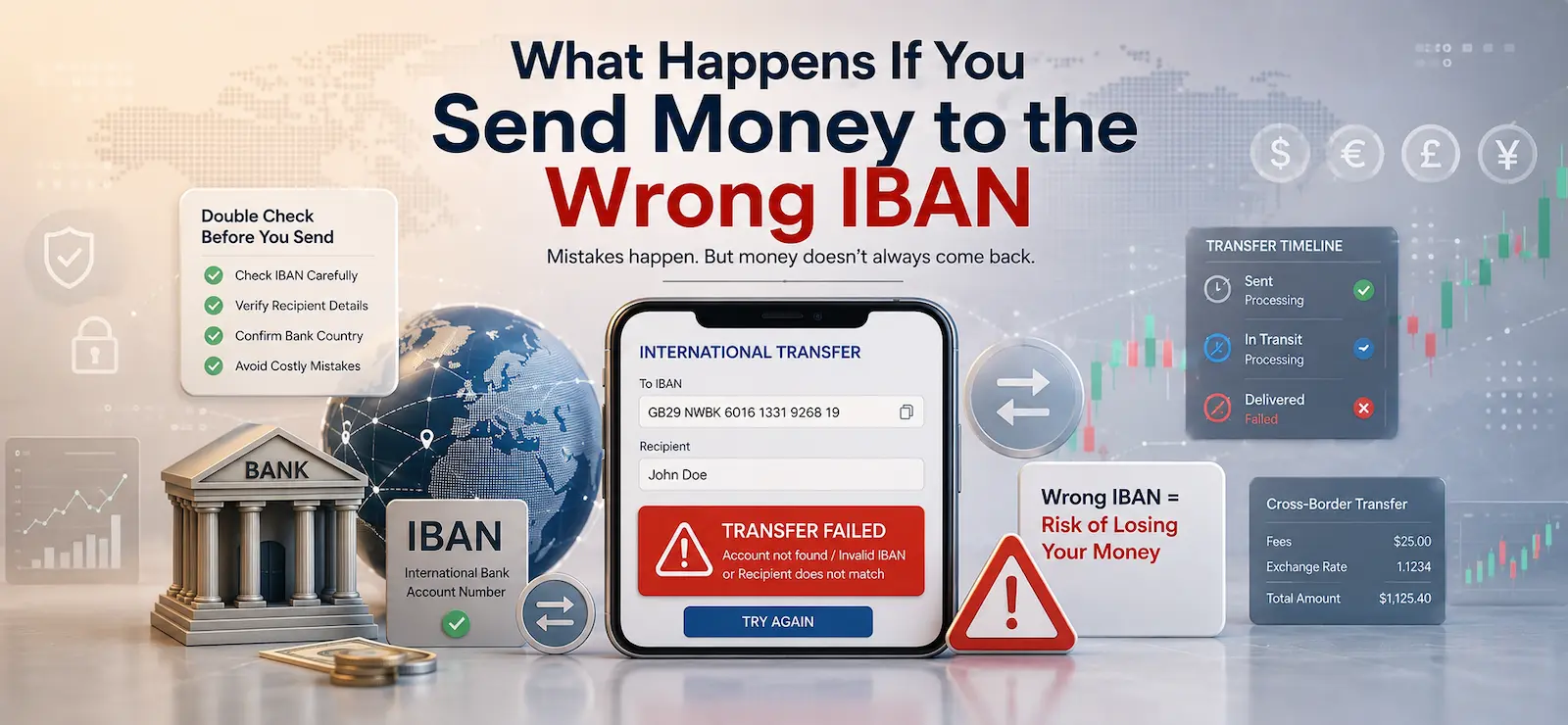

Sending money internationally is usually straightforward — until something goes wrong. One of the most common and stressful mistakes is entering the wrong IBAN. If you’ve ever wondered whether your money is lost forever or if you can recover it, this guide explains exactly what happens and what you should do next. New to IBANs? Start with our guide to what an IBAN is and how it works.
What happens if you send money to the wrong IBAN?
The outcome depends on the type of error. In most cases, one of the following three scenarios occurs:
1. The IBAN is invalid (best-case scenario)
If the IBAN is incorrect (wrong length, invalid digits), most banks automatically reject the transfer before it is processed. Your money never leaves your account or is returned within a short time.
Tip: Always validate the number before sending using our IBAN checker.
2. The IBAN is valid but belongs to the wrong account
This is the worst-case scenario. If the IBAN is structurally valid, the payment is processed on the IBAN alone. For euro transfers sent from a bank in a euro-area country, a Verification of Payee check now warns you before you confirm if the name you entered doesn’t match the account — but it’s a warning you can override, and many international transfers aren’t covered by it at all (more on this below).
In this case, the money is sent to the wrong person, and recovery becomes more complicated.
3. The transfer is still processing
If you catch the mistake early (before completion), your bank may be able to cancel or stop the transfer. Timing is critical.
Can you recover money sent to the wrong IBAN?
Yes — but it is not guaranteed.
Once a transfer is completed, it is generally irreversible. Your bank can request a recall, but success depends on the receiving bank and, in most cases, on the recipient agreeing to send the money back.
Under EU payment rules (Article 88 of the Payment Services Directive, PSD2), a payment made to the IBAN you entered counts as correctly executed, so your bank is not liable for your mistake. It must, however, make reasonable efforts to recover the funds, the receiving bank must cooperate with that effort, and if recovery fails your bank must give you, on written request, the information you need to bring a legal claim. Your bank may charge a fee for the recovery attempt if your account terms allow it.
Typical recovery process:
- Contact your bank immediately
- Request a payment recall or investigation
- Your bank contacts the receiving bank
- The recipient may be asked to return the funds
- If refused, legal action may be required
The process can take anywhere from a few days to several weeks depending on the payment route and cooperation.
Real example: what happens in practice
For example, if you send €2,000 to a wrong IBAN that exists, the payment may be credited within one working day. If reported quickly, your bank can request a recall, but the receiving bank must contact the account holder before returning funds.
How long does it take to get your money back?
- Invalid IBAN: 1–3 working days (automatic return)
- SEPA transfers: 5–15 working days (if recall succeeds)
- SWIFT transfers: can take longer due to intermediary banks
If the payment involved a currency conversion, any returned amount may be converted back at a different rate, so the sum you recover can differ from what you sent. You can follow the rate with our live exchange rates.
What should you do immediately?
If you realize the mistake, act fast:
- Contact your bank within minutes or hours
- Provide transaction details (amount, IBAN, reference)
- Request cancellation if still pending
- Request recall if already processed
The faster you act, the higher your chances of recovery.
Do banks check the recipient’s name?
For a long time, mostly not — the IBAN was the only identifier that mattered. That has changed for euro payments. Since 9 October 2025, banks and payment providers in euro-area countries must offer a free Verification of Payee check on euro credit transfers, both instant and standard. Before you confirm, your bank compares the name you entered with the name on the account and shows one of four results: match, close match (with the correct name shown), no match, or verification not possible.
A close match or no match is a warning, not a block — you can still choose to send, and if you do, you generally bear the risk. If your bank was required to offer the check and failed to, and that is why the money went to the wrong account, it must refund you without delay.
Providers in EU countries outside the euro area have until 9 July 2027 to offer the check, and it doesn’t cover non-euro payments. For many international transfers, the IBAN is still the only thing that gets checked — which is why validating it yourself matters.
How to avoid sending money to the wrong IBAN
- Always validate the IBAN before sending
- Double-check country code and length
- Use trusted saved beneficiaries
- Send a small test payment first
- Read the Verification of Payee result before you confirm — never ignore a no-match warning
- Confirm SWIFT/BIC using our SWIFT/BIC checker
- Verify country details with country codes directory
IBAN vs SWIFT — why both matter
An IBAN identifies the account, while a SWIFT/BIC code identifies the bank. For euro payments within SEPA the IBAN alone is enough — banks haven’t been allowed to require a BIC for SEPA payments since 2016 — but transfers outside SEPA and most non-euro payments still need both, and an error in either can cause delays, rejections, or misdirected payments.
Frequently Asked Questions
Can money be lost permanently?
Yes, in rare cases where the recipient refuses to return it and legal recovery fails.
Is the bank responsible for a wrong IBAN?
Not for your mistake. A payment made to the IBAN you entered counts as correctly executed. Your bank must still make reasonable efforts to recover the money, and if it failed to run a required Verification of Payee check and that caused the error, it must refund you.
Can I cancel an international transfer?
Only if it has not been completed yet. After that, only a recall is possible. Instant transfers settle within seconds, so they usually can’t be cancelled at all.
What is the safest way to send money internationally?
Always verify IBAN, confirm recipient details, and check live rates before sending.
Final thoughts
Sending money to the wrong IBAN can be stressful, but in many cases, it is recoverable if you act quickly. The key is prevention — always validate account details before confirming any transfer.
Use our tools to stay safe:
For related guidance, read Why Was My International Transfer Rejected?, our beginner’s guide What Is an IBAN?, and — if a company refuses your IBAN because it’s from another EU country — our guide to IBAN discrimination and your rights.
Disclaimer: This article is for informational purposes only and does not constitute financial advice. Exchange rates and market conditions change rapidly. Always conduct your own research before making any investment decisions.