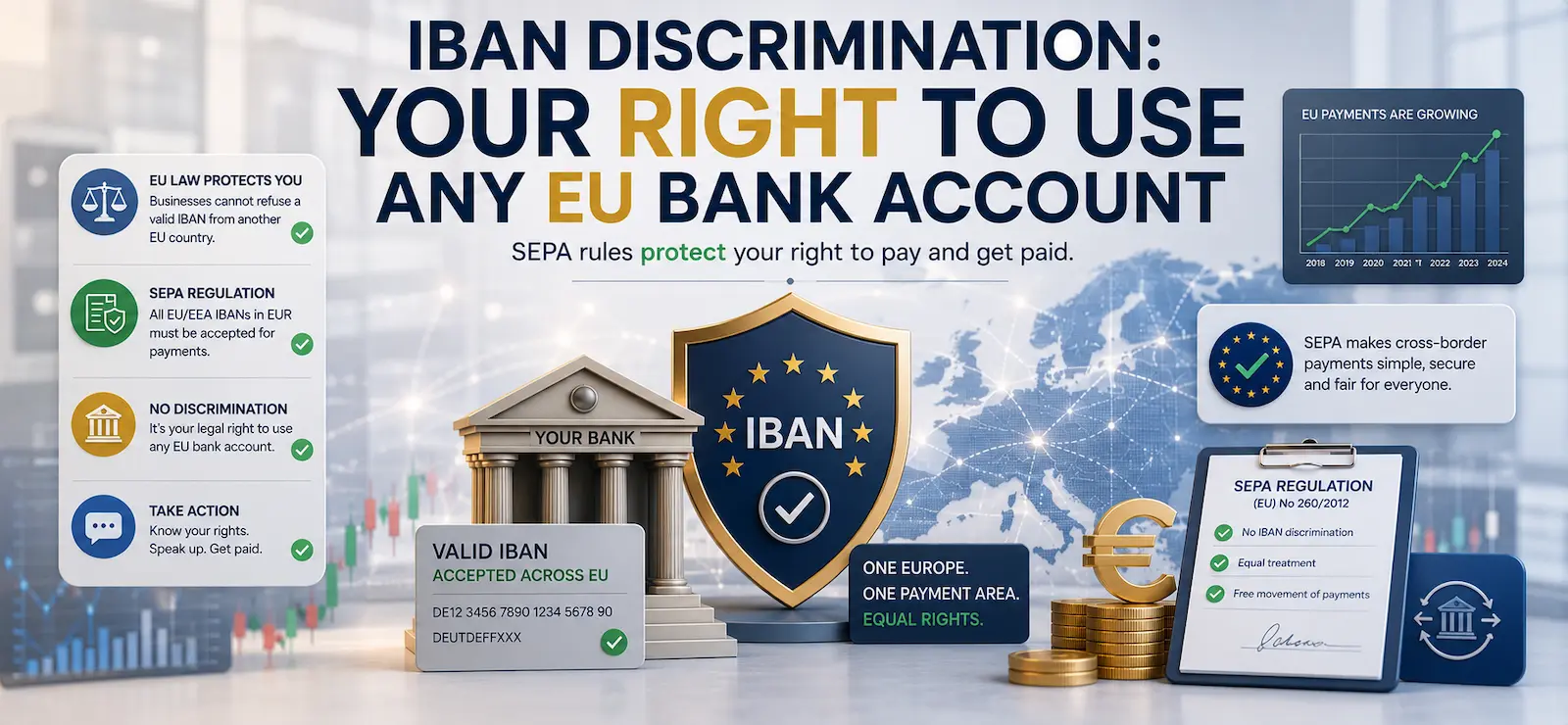

If you have ever tried to pay a French freelancer from a German bank account, or an employer in Spain has refused to pay your salary into your Belgian IBAN, you may have run into IBAN discrimination — and you may not have realised it is against the law.
Under EU law, for euro payments, a reachable payment account in one EU country must be treated the same as one in any other, whichever country issued it. A company that refuses your IBAN simply because it does not begin with their national country code is not applying a reasonable business rule — it is breaking a directly applicable EU regulation.
What Is IBAN Discrimination?
IBAN discrimination happens when a business, employer, landlord, or public authority refuses to accept a payment or set up a direct debit because the payer's or payee's IBAN was issued in a different EU country than expected. It usually shows up as one of these situations:
- Salary payments — an employer insists your salary can only be paid into a domestic IBAN, even though your foreign euro account is fully SEPA-reachable.
- Utility and subscription direct debits — an energy, telecom, or streaming provider refuses to collect payments from a non-domestic IBAN and demands a local account instead.
- Online checkout — an e-commerce site's payment form only accepts IBANs starting with its home country code.
- Rent and deposits — a landlord refuses a foreign-issued IBAN for rent transfers.
- Gym memberships and insurance — recurring direct debits are blocked unless the account is domestic.
None of these are legitimate reasons to refuse a valid IBAN. If the account is located in the EU (or Iceland, Liechtenstein or Norway) and reachable through SEPA, the country code printed on it is legally irrelevant for euro payments.
Is IBAN Discrimination Actually Illegal?
Yes — clearly and directly. Article 9 of Regulation (EU) No 260/2012, known as the SEPA Regulation, says that a payer making a euro credit transfer, or a payee accepting one or collecting a direct debit, must not specify which Member State the other party's payment account has to be in — as long as that account is located in the EU and reachable for SEPA payments. In plain terms: for euro payments, an employer, landlord or company can't insist on an account from a particular EU country. The regulation is directly applicable law in every EU member state — it does not need to be separately written into national legislation to take effect — and it has been incorporated into the EEA Agreement, which extends it to Iceland, Liechtenstein and Norway.
The rule was designed to make a simple promise real: SEPA was built so that a single euro account could be used the same way across the entire zone, whether you live in Lisbon, Warsaw, or Helsinki. Refusing an IBAN based on its country prefix defeats that purpose entirely, and the European Commission's own finance department lists it as a known, ongoing compliance problem — not a grey area.
A related rule, the Geo-blocking Regulation (EU) 2018/302, reinforces the same principle from a consumer-rights angle: businesses generally cannot apply different payment conditions to customers based on their nationality, residence, or the location of their payment account within the EU.
Does the New Verification of Payee Rule Change Anything?
Since 9 October 2025, banks and payment providers across the euro area have been required to offer a free Verification of Payee (VoP) check on euro credit transfers under the Instant Payments Regulation — comparing the payee name you enter with the name on the account before you confirm the payment. Providers in EU countries outside the euro area must follow by 9 July 2027. If you've read our guide on why international transfers get rejected, you'll recognise this as the check behind name-mismatch warnings.
It's worth being precise about what VoP does and does not do. VoP is a fraud-prevention name check — it exists to warn you if the name on an IBAN does not match who you think you're paying, and it warns rather than blocks. It has nothing to do with which country issued the IBAN, and it gives a business no new legal basis to reject a foreign-issued account. A company that tries to use "verification requirements" as an excuse for IBAN discrimination is simply misapplying an unrelated rule.
Where the Protection Does — and Doesn't — Apply
A few boundaries are worth understanding before you file a complaint:
- Currency matters. Article 9 protection applies specifically to euro-denominated SEPA credit transfers and direct debits. A payment in another currency isn't automatically covered by this rule, even between two EU accounts.
- The rule covers EU accounts, not the whole SEPA area. SEPA now spans 41 countries (European Central Bank, status May 2025), including Switzerland and the United Kingdom. But Article 9 protects payment accounts located in the EU — and, through the EEA Agreement, in Iceland, Liechtenstein and Norway. A Swiss or UK IBAN works for SEPA payments, but this rule doesn't stop a company from refusing it.
- Reachability is the condition. The account must be reachable for SEPA credit transfers or direct debits, which practically every euro account at an EU bank is. Within the EU, the rule isn't limited to a shorter list of "approved" countries.
How to Report IBAN Discrimination
If a business or employer refuses your valid EU IBAN, escalate in this order:
- Put it in writing. Ask the company or HR department in writing why the IBAN was refused, and reference Article 9 of Regulation (EU) No 260/2012 by name. Many refusals come from outdated internal systems rather than deliberate policy, and a clear written reference to the law resolves a surprising number of cases at this stage alone.
- Ask your bank or payment provider to help. Several banks and fintechs — particularly those issuing IBANs from a country different to where their customers live — have dedicated teams that intervene directly with merchants on a customer's behalf when discrimination is reported.
- Validate the IBAN first. Before escalating, confirm the IBAN itself is correctly formed using a tool like our free IBAN validator — a company can legitimately reject a genuinely invalid or mistyped IBAN, and you want to rule that out before making a legal argument.
- File a formal complaint. If the company still refuses, complain to the relevant national authority. In Germany this is BaFin; in France, the Banque de France or ACPR; in Italy, the AGCM, which has already issued fines over IBAN discrimination; and in Spain, the Banco de España. Most national regulators accept complaints online.
- Use a cross-border network if needed. For disputes involving a company based in a different EU country to you, the European Consumer Centres Network (ECC-Net) handles cross-border complaints, and FIN-NET connects national alternative-dispute-resolution bodies specifically for financial services.
Real-World Example
A Belgian freelancer moves to Portugal but keeps her Belgian IBAN for simplicity. A Portuguese client's accounting software rejects the invoice payment, flagging the account as "foreign." Because both countries are in SEPA and the invoice is in euros, the rejection is a straightforward Article 9 violation — the software's country-code filter, not the law, is the problem.
Practical Tips to Avoid the Hassle Entirely
- Know the exact citation — "Article 9 of Regulation (EU) No 260/2012" — before you raise the issue. Naming the specific article signals you know your rights and often shortcuts the dispute.
- Validate your own IBAN with a checker tool before sending it anywhere, so you can rule out a formatting error as the actual cause.
- If you regularly pay across borders, confirm the recipient's SWIFT/BIC code matches their bank — a mismatch there can look like an IBAN problem but isn't.
- Keep a written record of every refusal, including screenshots of error messages, in case you need to escalate to a regulator.
- Remember the protection is euro-specific and covers EU (and EEA) accounts — for a non-euro payment or a non-EU IBAN, different rules may apply.
Frequently Asked Questions
Is it illegal for a company to refuse my foreign IBAN?
Yes, if the payment is in euros and the account is located in the EU (or Iceland, Liechtenstein or Norway) and reachable for SEPA payments. Refusing it solely because of the country code violates Article 9 of Regulation (EU) No 260/2012. A Swiss or UK IBAN isn't covered by this rule.
Can my employer force me to open a local bank account?
No, if your salary is paid in euros and your existing account is located in the EU (or EEA) and reachable for SEPA payments — an employer cannot lawfully require a domestic account instead.
Does this rule apply to non-euro payments?
Not directly. Article 9 specifically protects euro-denominated SEPA credit transfers and direct debits. Payments in other currencies fall outside this particular protection.
What should I do first if my IBAN is rejected?
Confirm the IBAN itself is valid using an IBAN checker, then put your complaint in writing citing Article 9 before escalating to a regulator.
Does this rule cover every SEPA country?
No. SEPA covers 41 countries (ECB, status May 2025), but Article 9 protects accounts located in the EU's 27 member states and, through the EEA Agreement, Iceland, Liechtenstein and Norway. IBANs from other SEPA members, such as Switzerland and the United Kingdom, work for SEPA payments but aren't covered by this rule.
Final Thoughts
IBAN discrimination survives mostly because so few people know the rule exists — not because it's legally ambiguous. Once you can name the regulation and show the account is in the EU and SEPA-reachable, most refusals resolve within a single written complaint. Keep the outdated "foreign account" objection where it belongs: it stopped being a valid business reason once Article 9 took effect.
Use our free tools to stay ahead of the most common friction points: validate any account with our IBAN checker, confirm a bank's identity with our SWIFT/BIC lookup, and check any country's banking format with our country codes directory.
For related guidance, read our companion articles: What Is an IBAN?, What Happens If You Send Money to the Wrong IBAN? and Why Was My International Transfer Rejected?
Disclaimer: This article is for informational purposes only and does not constitute financial or legal advice. Regulations and enforcement practices vary by country and may change. Always verify current rules with the relevant national authority or a qualified professional before relying on this information.