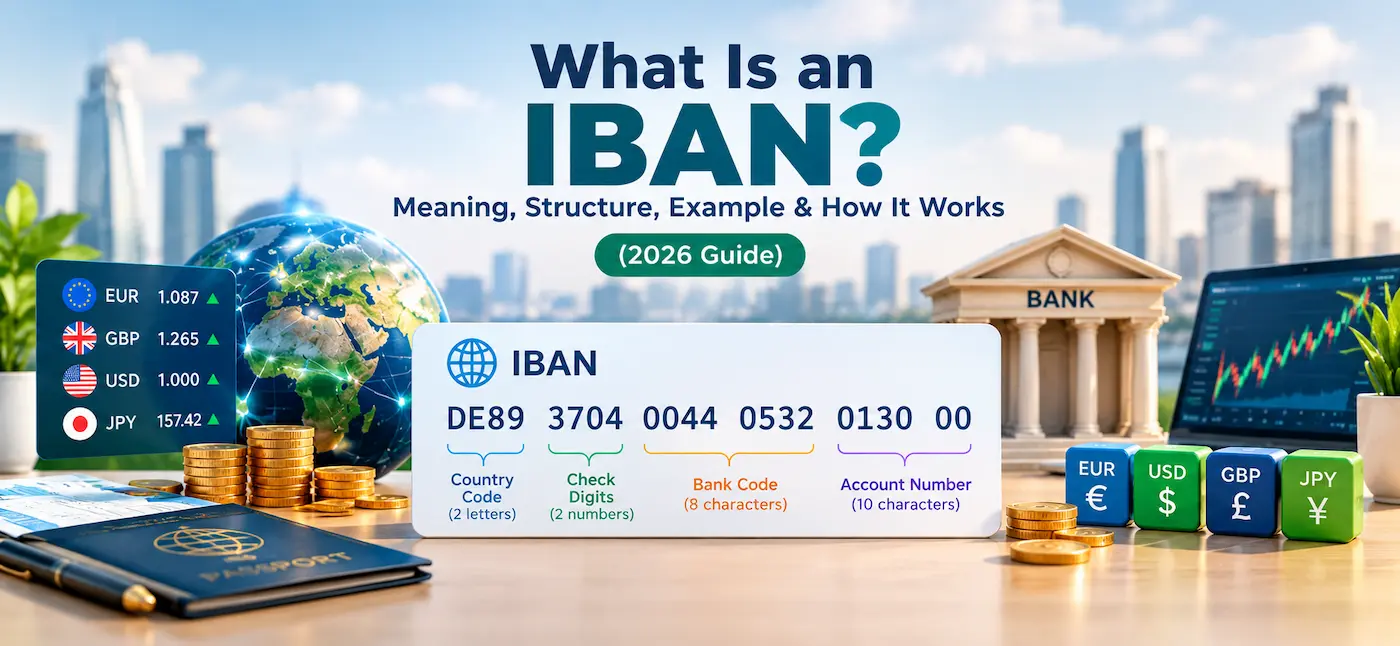

An IBAN (International Bank Account Number) is a standardised format used to identify bank accounts for international and European payments. The format was created so that any bank, anywhere it is used, can check in seconds whether an account number is structurally valid — without needing to understand that country's own domestic banking format first.
A simple way to think about it: an IBAN is a universal postal address for your bank account. Just as a postal address tells a courier which country, city, and street to deliver to, an IBAN tells a bank which country, which bank, and which account to send money to — all in one standardised string of characters.
You can check whether any IBAN is correctly formatted using our free IBAN Checker.
Why Was the IBAN Introduced?
Before IBAN existed, cross-border payments relied on each country's own domestic account-numbering system. A bank in one country had no reliable way to validate an account number from a country with a completely different format, so transfers were frequently delayed, rejected, or — in the worst cases — sent to the wrong account entirely.
IBAN solves this with a single structure that works the same way everywhere it is used:
- Reduces payment errors by making account numbers mathematically self-checking
- Speeds up international and SEPA transfers by removing manual verification steps
- Standardises bank account formats across more than 80 countries
- Improves transaction security by catching typos before a payment is sent, not after
IBAN Example, Broken Down
Here is a standard example IBAN for a German bank account:
DE89 3704 0044 0532 0130 00
- DE — country code (Germany)
- 89 — check digits, used to validate the whole number mathematically
- 3704 0044 — bank code (identifies the specific bank)
- 0532 0130 00 — the account number itself
Every country follows this same general pattern — country code, then check digits, then domestic account details — but the exact length and internal structure differs by country. You can look up any country's format in our country codes directory.
The Structure of an IBAN
An IBAN can be up to 34 alphanumeric characters long and always follows the same three-part structure:
- Country code — 2 letters, following the ISO 3166-1 standard (the same alpha-2 codes used in SWIFT codes and country-code top-level domains)
- Check digits — 2 numbers, calculated mathematically from the rest of the IBAN
- BBAN (Basic Bank Account Number) — the remaining characters, which encode the bank, sometimes a branch, and the account number in that country's own domestic format
How IBAN Validation Actually Works
Every IBAN is self-checking using a calculation called MOD-97 (formally, ISO 7064 MOD 97-10). This is what lets a bank — or our checker tool — catch a typo instantly, before any money moves:
- Move the first four characters (the country code and check digits) to the end of the string
- Replace every letter with a number, using A=10, B=11, C=12, and so on through Z=35
- Treat the result as one large number and divide it by 97
- If the remainder is exactly 1, the IBAN is correctly formatted
A remainder of anything else means at least one character was typed, copied, or scanned incorrectly. This is also why an IBAN with the right number of digits can still be invalid — the check digits catch far more than just length mistakes. You can run this check automatically with our free IBAN validator.
Which Countries Use IBAN?
IBAN started in Europe but has since been adopted well beyond it. Today more than 80 countries use IBAN, including:
- All European Union and SEPA countries
- Most of the Middle East, including the UAE, Saudi Arabia, and Qatar
- Several South Asian and Central Asian countries, including Pakistan
- Many Caribbean nations
Notable countries that do NOT use IBAN:
- United States
- Canada
- Australia
- India (uses IFSC codes for domestic transfers instead)
- China
If you're sending money to or from one of these countries, you'll typically need a SWIFT/BIC code and the recipient's domestic account number instead of an IBAN.
IBAN Length by Country
IBAN length is fixed per country — never optional or variable — which is itself one of the first things an IBAN checker verifies:
- Germany: 22 characters
- United Kingdom: 22 characters
- France: 27 characters
- Spain: 24 characters
- United Arab Emirates: 23 characters
- Saudi Arabia: 24 characters
- Pakistan: 24 characters
See the full list of country codes and formats in our country codes directory.
IBAN vs SWIFT/BIC Code — What's the Difference?
These two are often confused, but they identify different things:
- IBAN identifies the specific account the money should land in
- SWIFT/BIC identifies the bank itself, so the payment network knows which institution to route the transfer to
Transfers outside SEPA, and most non-euro payments, need both. For euro payments within SEPA the IBAN alone is enough — banks haven't been allowed to require a BIC for SEPA payments since 2016. Learn more in our SWIFT/BIC code guide.
How to Find Your IBAN
- Your bank's mobile app or online banking portal, usually under account details
- Your bank statement or welcome letter
- Your bank card, in some countries
- By calling or visiting your bank directly
Common IBAN Mistakes
- Entering the wrong country code prefix
- Missing or extra digits, especially when typing a long IBAN manually
- Confusing similar-looking characters, such as the letter O and the digit 0
- Copying an old or closed account's IBAN by mistake
If a transfer has already failed, our guide on why international transfers get rejected covers the nine most common causes and how to fix each one.
Is It Safe to Share Your IBAN?
Yes, with one caveat. Sharing your IBAN so someone can send you money is standard practice, and an IBAN can't be used to withdraw cash or make card payments. The real risk is a fraudulent SEPA direct debit: the business collecting a direct debit holds the mandate, and your bank doesn't see it, so someone with your IBAN could misuse it. If that happens you can get the money back — with no questions asked within 8 weeks for SEPA Core direct debits, and up to 13 months if you never authorised the payment. Check your statements, and only share your IBAN with people and businesses you trust.
What Happens If You Use the Wrong IBAN?
If the IBAN fails the MOD-97 check, most banks will reject the transfer automatically before any money leaves your account. The real risk is a valid IBAN that simply belongs to someone else — payments are processed on the IBAN, so a correctly formatted IBAN that belongs to someone else can still send your money to a stranger. For euro transfers from a bank in a euro-area country, a Verification of Payee check now compares the name you entered with the account holder's name before you confirm, and warns you if they don't match — but it's a warning you can override, so take it seriously. Our guide on what happens if you send money to the wrong IBAN covers recovery options in detail.
Frequently Asked Questions
What does IBAN stand for?
IBAN stands for International Bank Account Number. It's an internationally standardised way of writing a bank account number so it can be validated and processed consistently across borders.
How long is an IBAN?
Between 15 and 34 characters, depending on the country. The length is fixed per country — for example, every German IBAN is exactly 22 characters, and every French IBAN is exactly 27.
Can I calculate my own IBAN from my account number?
In principle, yes: the two check digits are calculated from your bank code and account number using the same MOD-97 formula. In practice, take your IBAN from your bank's app or statements rather than building it by hand — a single wrong digit in the bank code or account number produces a different IBAN that still passes validation. Our IBAN checker validates IBANs; it doesn't generate them.
Does every bank account have an IBAN?
Only accounts in countries that have adopted the IBAN standard. Accounts in the United States, Canada, Australia, and a number of other countries use different identification systems instead.
Is an IBAN the same as an account number?
No. The IBAN contains your account number as part of it, but it also adds a country code and check digits, which your plain domestic account number does not have on its own. See our full comparison: IBAN Number vs Account Number.
Final Thoughts
An IBAN is simpler than it looks once you know the three parts — country code, check digits, and your bank's own account details — and the MOD-97 check built into every valid one is exactly why typos get caught so reliably. Before sending or sharing an IBAN, it only takes a few seconds to confirm it's correctly formed.
Validate any IBAN instantly with our free IBAN Checker, look up a country's exact format in our country codes directory, or confirm a bank's SWIFT/BIC code with our SWIFT/BIC lookup.
For related reading, see our guides on what happens if you send money to the wrong IBAN, why international transfers get rejected, and your legal right to use any EU bank account.
Disclaimer: This article is for informational purposes only and does not constitute financial advice. Exchange rates and market conditions change rapidly. Always conduct your own research before making any investment decisions.