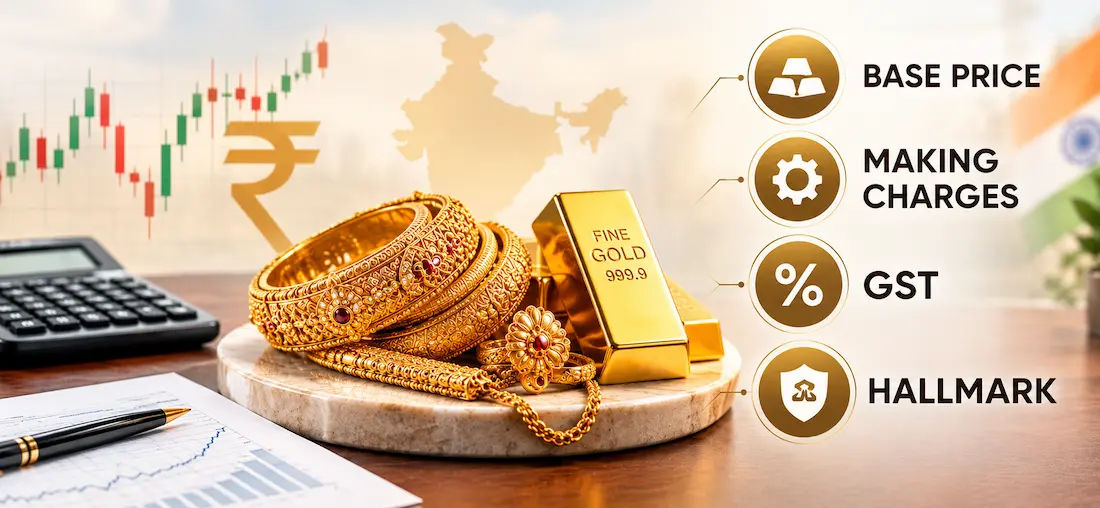

You check the gold rate in the morning, do the maths for a 10-gram chain, and walk into the shop with a number in your head. Then the bill comes out ₹20,000 higher. Nobody has cheated you, at least not necessarily. The rate you saw is only the starting point. Making charges, GST and sometimes a hallmarking fee are added on top, and the rate itself is built from the world gold price, the rupee and India's import duty.
This guide works through each layer with real numbers from October 2026. By the end you should be able to check any jewellery bill line by line, and you'll know which parts are worth arguing about.
💡 Quick answer: In India, the price of gold jewellery = (gold rate per gram for that karat × net weight) + making charges + 3% GST on the total. The gold rate itself comes from the international gold price, converted into rupees at the USD/INR rate, plus 15% import duty (in force since 13 May 2026).
Where the Indian Gold Rate Comes From
India imports almost all the gold it uses, so the rate you see on a jeweller's board starts abroad. It is built in four steps.
1️⃣ The world price in US dollars. Gold is traded globally in US dollars per troy ounce (31.1035 grams). This is the price on our live gold charts, and it moves with interest rates, the dollar and investor demand. Our guide to what moves gold prices covers the main drivers, and our analyst Vaneesa Lenz looks at why gold reacts to real interest rates faster than to inflation headlines in this piece for TalkMarkets.
2️⃣ Conversion into rupees. The dollar price is divided by 31.1035 to get a price per gram, then multiplied by the USD to INR exchange rate.
3️⃣ Import duty. The government raised the import duty on gold from 6% to 15% (10% basic customs duty plus 5% agriculture cess) with effect from 13 May 2026. Every gram that enters the country carries that cost, and it flows straight into the domestic rate.
4️⃣ Local market adjustments. Bullion dealers and jewellers' associations then set the day's rate for their market. The India Bullion and Jewellers Association (IBJA) publishes benchmark rates, and city associations publish their own. These can sit slightly above or below the imported cost depending on demand. After the May duty hike, for example, the World Gold Council reported that Indian prices slipped to a deep discount to the imported cost as buyers held back.
Here is how those steps worked out on 13–14 October 2026:
| Step | Figure | Result |
|---|---|---|
| World gold price | about $4,182 per ounce | $134.45 per gram |
| Converted at USD/INR | about ₹95.22 per dollar | ₹12,802 per gram |
| Plus 15% import duty | ₹12,802 × 1.15 | ₹14,722 per gram |
| Reported 24K market rate (14 Oct) | ₹1,48,260 – ₹1,49,670 per 10 g, depending on city | about ₹14,830 per gram |
The landed cost and the market rate ended up within about 1% of each other, which is what you'd expect when the market is calm. 🔍 One thing the table makes clear: about 13% of what you pay for the metal itself is import duty, before a single rupee of making charges or GST.
Why the Rupee Matters as Much as the Gold Price
Because the rate is converted from dollars, a weaker rupee makes gold dearer even on days when the world price doesn't move. If the rupee slipped from ₹88 to ₹95 per dollar, gold would cost about 8% more in India with no change at all in the international price. That is why Indian gold can hit record highs in rupees while the dollar price is going sideways. You can follow both sides on our USD/INR page and our India gold price page.
For families buying with money earned abroad, a second exchange rate matters too. Gold bought with riyals, dirhams or pounds depends on SAR to INR, AED to INR or GBP to INR on the day the money is sent home. A good transfer rate can cancel out a lot of the difference between two jewellers. Our guide to sending USD or AED to India explains how to get a better rate on the transfer itself.
How 22K, 18K and Other Karat Rates Are Worked Out
Most Indian jewellery is 22 karat, which is 91.6% pure gold. That's where the familiar stamp 916 comes from. Jewellers usually quote 22K and 24K rates separately, but the 22K rate is essentially the 24K rate scaled down by purity.
| Karat | Hallmark fineness | Gold content | Approx. rate per gram at ₹14,830 for 24K |
|---|---|---|---|
| 24K | 999 / 995 | 99.9% | ₹14,830 |
| 22K | 916 | 91.6% | ₹13,598 |
| 18K | 750 | 75.0% | ₹11,134 |
| 14K | 585 | 58.5% | ₹8,684 |
| 9K | 375 | 37.5% | ₹5,567 |
The reported 22K market rate on 14 October was around ₹13,590–13,720 per gram, right in line with the purity maths. If a shop's 22K rate is noticeably higher than 91.6% of its own 24K rate, ask why. Our gold karats guide explains purity, tola conversions and how to price any karat from the 24K rate.
Making Charges: The Part That Varies Most
Making charges pay for turning raw gold into jewellery: design, labour, casting, polishing, and the small amount of metal lost along the way. Unlike the gold rate, which is almost the same everywhere in a city, making charges are set by each jeweller and change from piece to piece.
You will usually see them in one of three forms:
- A percentage of the gold value, such as 12%. This is the most common format at large chains.
- A flat amount per gram, such as ₹1,200 per gram. It's easier to compare between shops because it doesn't rise when the gold rate rises.
- A fixed price per piece, often used for light jewellery and coins.
In South India you may also see "wastage" or "VA" (value addition) on the bill. It's the same idea under a different name: an allowance for metal lost during manufacturing, charged as a percentage.
Plain, machine-made chains and bangles often carry single-digit making charges, while intricate handcrafted, antique or temple designs can go well past 20%. Making charges are also the one part of the bill that is genuinely negotiable, especially on heavier pieces and outside the peak festival rush.
⚠️ Watch the weight. If a piece has stones, kundan or enamel, ask for the net gold weight as well as the gross weight. You should pay the gold rate on the gold only, not on the stones, and making charges should be worked out on the gold weight too.
GST on Gold Jewellery: 3%, and When 5% Applies
GST on gold is 3% (1.5% CGST plus 1.5% SGST, or 3% IGST between states). The GST Council left this rate unchanged in the September 2025 rate overhaul.
Where people get confused is the making charge. When you buy a ready-made piece from a jeweller, the sale is treated as one supply of jewellery, so 3% GST applies to the full price, including making charges. The 5% rate you may have heard about applies to job work, when you give your own gold to a jeweller to be made into something new and pay only for the labour.
Some invoices still show 5% on making charges for ready-made jewellery. If yours does, it's fair to ask the jeweller to explain it. A few other points:
- ✅ Selling old gold: no GST is charged when an individual sells old jewellery to a jeweller.
- ✅ Exchanging old gold: you pay GST on the new piece. Practice on whether it's charged on the full value or only on the difference varies, so check how your bill calculates it.
- ✅ Coins, bars and digital gold: also 3% GST. Digital gold platforms may add 18% GST on storage or service fees.
- ✅ Hallmarking: the official charge is ₹45 per piece (plus GST). Most jewellers absorb it, but some list it separately.
A Worked Example: A 10-Gram 22K Gold Chain
Let's put it all together using a 22K rate of ₹13,600 per gram and a making charge of 12%.
| Line on the bill | Calculation | Amount |
|---|---|---|
| Gold value | 10 g × ₹13,600 | ₹1,36,000 |
| Making charges (12%) | ₹1,36,000 × 12% | ₹16,320 |
| Taxable value | gold + making | ₹1,52,320 |
| GST (3%) | ₹1,52,320 × 3% | ₹4,569.60 |
| Total | ₹1,56,889.60 |
So a chain that is "worth" ₹1,36,000 at the day's rate costs about ₹1,56,890 over the counter, roughly 15% more than rate × weight. That gap is the reason so many people feel the bill doesn't match the rate they saw.
Now look at how much each factor actually moves the final price:
| What changes | Effect on the same 10 g chain |
|---|---|
| Making charge of 8% instead of 20% | ₹1,51,286 vs ₹1,68,096 – a difference of about ₹16,800 |
| Import duty of 6% (before May 2026) instead of 15% | about ₹12,300 cheaper |
| Buying in the cheapest vs the dearest big city (14 Oct rates) | roughly ₹1,300 |
💡 The takeaway: shopping around for a lower making charge saves you far more than chasing the city or the day with the lowest gold rate. On this chain, the making charge mattered about ten times more than where you bought it.
Hallmark and HUID: How to Check Purity
Since June 2021, gold jewellery sold in districts covered by India's mandatory hallmarking rules must carry a BIS hallmark, and since April 2023 that hallmark must include a HUID. After the sixth phase of rollout in March 2026, mandatory hallmarking covers 380 districts, and more than 60 crore pieces have been hallmarked with a HUID since 2021.
A valid hallmark on gold jewellery has three parts:
- The BIS logo, showing it was tested at a recognised centre.
- The purity grade, written as karat and fineness, such as 22K916 or 18K750. The permitted grades are 9K, 14K, 18K, 20K, 22K, 23K and 24K. 9K was added in July 2025.
- The HUID, a 6-character alphanumeric code unique to that piece.
You can check any HUID yourself in the official BIS Care app using the "Verify HUID" option. It shows the purity and the registration details of the jeweller who sold the piece. Do it in the shop, before you pay. It takes less than a minute.
If hallmarked jewellery later turns out to be below its marked purity, BIS rules entitle you to compensation of twice the value of the shortfall for the piece's weight, plus testing charges. Any BIS-recognised assaying and hallmarking centre will test jewellery for consumers for a fee. Old jewellery without a hallmark can still be sold or exchanged, but expect it to be tested first and valued on its real purity.
Why Gold Rates Differ Between Cities and Shops
On 14 October 2026, reported 24K rates ranged from about ₹1,48,260 per 10 grams in some cities to ₹1,49,670 in Mumbai, Chennai, Kolkata and Hyderabad, a spread of about ₹1,400. The gap comes from local jewellers' association rates, transport and insurance costs, and how strong local demand is that week. Individual shops may also add a small margin on top of the association rate.
As the worked example showed, these differences are small next to making charges. They matter more if you're buying coins or bars, where the making charge is low and the rate is most of the price.
Before You Buy This Dhanteras: A Quick Checklist
Dhanteras falls on 6 November 2026, and it is the busiest gold-buying day of the year. Shops are crowded and bills get written fast, so it pays to go in prepared.
- Check the day's rate before leaving home, for both 22K and 24K, so you can spot an inflated board rate.
- Ask how the making charge is calculated: a percentage, per gram or per piece. Get it in writing, and compare two or three shops.
- Ask for the net gold weight on anything with stones.
- Verify the HUID in the BIS Care app before paying.
- Read the invoice. It should show weight, karat, rate per gram, making charges, GST and the HUID of each piece.
- Know the payment rules. You must give your PAN for purchases of ₹2 lakh or more, and jewellers can't accept ₹2 lakh or more in cash for a single purchase.
- Ask about buyback and exchange terms now, not when you want to sell. Find out what deduction, if any, the shop makes on its own hallmarked gold.
Jewellery, Coins or Gold Funds?
If your aim is investment rather than wearing the gold, making charges are money you won't get back when you sell. Coins and bars from a jeweller or refiner carry much lower making charges, and gold ETFs and other paper options carry none at all. Our guides on how to invest in gold and gold ETFs vs physical gold compare the costs, and our gold price forecast for 2026 looks at where prices could go next.
Is Gold Cheaper in Dubai or Saudi Arabia?
Dubai is usually cheaper, and the main reason is the import duty. Gold rates in the Gulf follow the world price with no 15% duty added, VAT in the UAE is 5%, and tourists can reclaim it on eligible purchases. That's why many families ask relatives working in the UAE to buy jewellery there. Saudi Arabia is a closer call: jewellery there carries 15% VAT, which cancels out much of the duty saving.
The catch is bringing it home. India's duty-free allowance for jewellery is small, it depends on how long the passenger has lived abroad, and anything above it is taxed at customs, so the saving can disappear at the airport. Compare the gold price in Dubai and the gold price in Saudi Arabia with the Indian rate, and read our guides to buying gold in Dubai and buying gold in Saudi Arabia before deciding.
Frequently Asked Questions
How is the gold rate calculated in India?
The international gold price in US dollars per ounce is converted to rupees per gram using the USD/INR exchange rate. Import duty, currently 15%, is then added, and local bullion and jewellers' associations set the final daily rate for their market.
Why is the jewellery price higher than the gold rate?
The gold rate covers only the metal. A jewellery bill adds making charges, typically several percent to over 20% of the gold value, and 3% GST on the total. Together these usually add 10–25% to the rate × weight figure.
Is GST on gold 3% or 5%?
For ready-made jewellery bought from a jeweller, GST is 3% on the full price, including making charges. A 5% rate applies to job work, where you supply your own gold and pay the jeweller only to make the piece.
What does 916 gold mean?
916 means the gold is 91.6% pure, the same as 22 karat. It is the most common purity for Indian jewellery and appears in the hallmark as 22K916.
How do I check if my gold is real?
Look for the BIS hallmark: the BIS logo, the purity grade and a 6-character HUID. Enter the HUID in the BIS Care app to confirm the details. For older or unhallmarked pieces, a BIS-recognised assaying and hallmarking centre can test the purity for a small fee.
Are making charges negotiable?
Usually, yes. Making charges are set by each jeweller rather than by the market, so there is room to negotiate, especially on heavier and machine-made pieces and outside peak festival days.
Does a weaker rupee make gold more expensive?
Yes. Gold is priced in dollars, so when the rupee weakens against the dollar, the rupee price of gold rises even if the world price stays the same.
Why is gold cheaper in Dubai than in India?
Mainly because India adds a 15% import duty that the UAE doesn't, and visitors to the UAE can reclaim VAT on eligible purchases. Customs limits on bringing jewellery back to India can wipe out the saving, so check them before you buy.
Final Thoughts
Once you can see the layers, a gold bill stops being mysterious. The world price and the rupee set the base, the import duty adds a large and fixed slice on top, and GST is the same everywhere. That leaves the making charge as the one number you can really influence. Check the HUID, ask for the breakdown, and compare making charges, not just rates.
Track the gold price in India live, follow the rupee against the dollar, or see how the gold price in Pakistan compares across the border.
For related reading, see What Moves Gold Prices?, Is Gold a Good Inflation Hedge? and How to Invest in Gold.
Disclaimer: This article is for informational purposes only and does not constitute financial, tax or legal advice. Gold rates, duty rates and tax rules change, and the rates quoted here are examples from October 2026. Always check the current rate and the rules that apply to you before buying.