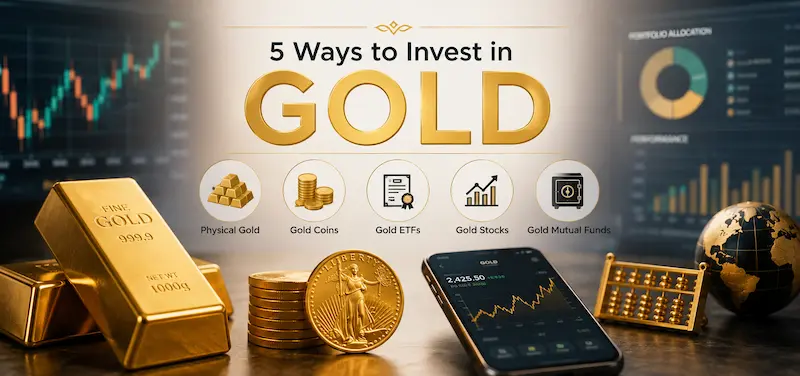

How to Invest in Gold — The Direct Answer
The five main ways to invest in gold are physical gold (bars and coins), gold ETFs, gold mining stocks, gold futures and options, and digital or allocated gold. For most everyday investors, a low-cost gold ETF such as SPDR Gold MiniShares (GLDM) offers the simplest, cheapest exposure to the gold price, while physical gold suits those who want a tangible asset with zero counterparty risk. Mining stocks and futures offer higher potential returns with far higher risk, and digital gold bridges the gap between physical ownership and the convenience of an app. With gold trading near $4,600 per ounce in late August 2026 — down from its January 2026 record of $5,589 but still up more than 150% over five years — the method you choose matters as much as the decision to buy gold at all.
This guide compares all five methods across cost, risk, liquidity, and real returns, using the current 2026 gold price as the backdrop. You can track the live XAU/USD gold spot price in real time on FloatForex, updated every 2 minutes, alongside the current gold-to-silver ratio, before deciding where to put your money.
What Is the Gold Price Today, and Why Does It Matter for Investing?
As of 28 August 2026, the gold price today sits at approximately $4,600 per troy ounce (around $148 per gram and $148,000 per kilo) in US dollars. The metal set an all-time high of $5,589 per ounce on 28 January 2026 before correcting into the $4,500–$5,000 consolidation zone where it has traded through the middle of the year. Every method of gold investing below tracks this same underlying spot price — the difference is in how much you pay to get exposure to it, how fast you can sell, and how much risk sits between you and the metal.
Here is the current gold price across the major weights and currencies that matter most to international investors:
| Measure | Approx. Gold Price (late Aug 2026) |
|---|---|
| Gold price per ounce (USD) | ~$4,600 |
| Gold price per gram (USD) | ~$148 |
| Gold price per kilo (USD) | ~$148,000 |
| Gold price per gram (India, 24K) | ~₹15,980 |
| Gold price per gram (Pakistan, 24K) | ~₨41,500 |
| Gold price per gram (UAE, 24K) | ~AED 543 |
| Gold-to-silver ratio | ~67:1 |
Prices are indicative spot levels and move constantly during trading hours. Local retail prices include dealer premiums, making charges, and taxes. Always check a live source before transacting. Buying in a specific market? Check the live local rate on our dedicated pages for the gold price in India and the gold price in Saudi Arabia. For the full outlook on where prices go next, see our Gold Price Forecast 2026 — Will XAU/USD Hit $5,000, $6,000 or Higher?
The 5 Ways to Invest in Gold — Side-by-Side Comparison
Before diving into each method, here is the full picture at a glance. This is the fastest way to see which gold investment vehicle fits your goal, budget, and risk tolerance.
| Method | Upfront Cost | Ongoing Cost | Liquidity | Risk Level | Best For |
|---|---|---|---|---|---|
| Physical gold (bars & coins) | 3–8% premium over spot | Storage & insurance | Days to weeks | Low | Long-term holders, crisis hedging, wealth transfer |
| Gold ETFs | Brokerage commission (often $0) | 0.10–0.40% expense ratio | Instant (market hours) | Low–Medium | Portfolio diversification, retirement accounts |
| Gold mining stocks | Brokerage commission | None (or fund fee) | Instant (market hours) | High | Investors seeking leveraged upside to gold price |
| Gold futures & options | Margin deposit | Rollover & financing costs | Instant, but complex | Very High | Experienced traders and hedgers only |
| Digital / allocated gold | 1–3% spread + small fee | Storage fee (~0.1–0.5%) | Fast (same/next day) | Low–Medium | Investors wanting physical backing without hassle |
1. Physical Gold — Bars, Coins, and Bullion
Physical gold means owning the actual metal: bars, sovereign coins, or allocated bullion you hold yourself or store in a vault. It is the oldest form of gold investing and the only one with zero counterparty risk — no fund, custodian, or broker sits between you and the metal.
How it works: You buy from a dealer, mint, or bank at the spot gold price plus a premium. A 1 oz American Gold Eagle or Canadian Maple Leaf typically carries a 3–6% premium; smaller 1-gram bars can run 8–15% over spot. Once purchased, there are no annual fees, but you must store and insure it.
Best physical products for investment: Stick to widely recognised, low-premium items — 1 oz sovereign coins (Gold Eagle, Maple Leaf, Britannia, Krugerrand, Philharmonic) and cast bars from recognised refiners (PAMP Suisse, Valcambi, Perth Mint). Avoid numismatic collector coins and jewellery for pure investment — the markups destroy your returns.
Pros: No counterparty risk, tangible, portable, culturally durable, and a genuine hedge against systemic financial collapse. Cons: High purchase premiums on small amounts, storage and insurance costs, and slow, sometimes costly liquidation. For a deeper breakdown of physical versus paper gold, read our full comparison: Gold ETF vs Physical Gold — Which Is the Better Investment.
2. Gold ETFs — The Simplest Way to Track the Gold Price
A gold exchange-traded fund holds physical bullion in vaults and issues shares that trade on the stock exchange. Buy one share and you own a fractional claim on the gold — but you never take delivery. For most investors, this is the most practical way to get gold exposure.
How it works: You buy shares through any brokerage account, just like a stock. The fund tracks the spot gold price within a fraction of a percent. You pay an annual expense ratio instead of storage costs.
| Gold ETF | Ticker | Expense Ratio | Best For |
|---|---|---|---|
| SPDR Gold MiniShares | GLDM | 0.10% | Cost-conscious long-term holders |
| iShares Gold Trust | IAU | 0.25% | Balance of cost and liquidity |
| Aberdeen Physical Gold | SGOL | 0.17% | Swiss-vaulted preference |
| SPDR Gold Shares | GLD | 0.40% | Maximum liquidity for active traders |
Pros: Instant liquidity, tiny costs, no storage hassle, and full compatibility with tax-advantaged accounts like IRAs and ISAs. Cons: You own a claim, not the metal, so there is some counterparty risk. In the US, gold ETFs are taxed as collectibles at up to a 28% long-term capital gains rate. New to ETFs entirely? Start with our Best ETFs to Buy in 2026 — Top 10 by Category for the full picture on how ETFs work across all categories.
3. Gold Mining Stocks — Leveraged Exposure to the Gold Price
Instead of owning gold, you own shares in the companies that dig it out of the ground — miners like Newmont, Barrick, Agnico Eagle, or a basket of them through a fund like GDX (VanEck Gold Miners ETF).
How it works: Mining company profits rise faster than the gold price itself. If a miner's cost to produce an ounce is $1,500 and gold rises from $4,000 to $4,600, that extra $600 flows almost entirely to the bottom line — so the stock can climb far more than 15% on a 15% gold move. This is called operating leverage.
Pros: Potential for outsized gains in a gold bull market, plus some miners pay dividends. Cons: This is not a pure gold play. Mining stocks carry company-specific risks — management decisions, mine accidents, rising energy costs, political risk in the country of operation, and broad stock-market sentiment. They can fall even when gold rises. Treat mining stocks as an equity investment influenced by gold, not as gold itself.
4. Gold Futures and Options — For Experienced Traders Only
Gold futures are contracts to buy or sell gold at a set price on a future date, traded on exchanges like COMEX. Options give the right, but not the obligation, to do so. These are powerful tools for professionals and a fast way to lose money for everyone else.
How it works: You control a large amount of gold with a small margin deposit — high leverage that magnifies both gains and losses. A modest move against your position can trigger a margin call and wipe out your deposit.
Pros: Maximum leverage, useful for hedging, and no physical storage. Cons: Very high risk, complex mechanics, rollover and financing costs, and the real possibility of losing more than your initial outlay. Unless you are an experienced trader who fully understands margin and expiry, this method is best avoided. If you want to understand the trading mechanics behind price moves, our technical analysis guides on the RSI indicator and the MACD indicator are a good starting point.
5. Digital and Allocated Gold — Physical Backing Without the Hassle
Digital gold lets you buy fractional amounts of real, vaulted gold through an app or platform, with each unit backed by physical metal allocated in your name. Services like BullionVault, Kinesis, and various bank and fintech offerings sit in this category.
How it works: You buy gold in small increments — sometimes as little as a fraction of a gram — at close to the spot price, with the metal stored in a professional vault. You can typically sell back instantly and, with some providers, even take physical delivery.
Pros: Low entry point, physical backing, fast liquidity, and no personal storage worries. Cons: You rely on the platform's integrity and solvency, storage fees apply, and product quality varies widely — always confirm the gold is allocated (specific bars legally yours) rather than unallocated (a general claim on the pool). This method is ideal for younger investors or anyone wanting to build a gold position gradually alongside a strategy like dollar-cost averaging.
Which Gold Investment Method Is Right for You? — 5 Scenarios
The best way to invest in gold depends entirely on your goal. Here is how the five methods map to real situations:
- You want a simple 5–10% portfolio allocation: Gold ETF (GLDM or IAU). Cheap, liquid, and retirement-account friendly.
- You want insurance against currency collapse or systemic risk: Physical gold in a private vault or at home. It is the only true zero-counterparty option.
- You want to bet aggressively on higher gold prices: Gold mining stocks or a miners ETF like GDX — accepting the extra risk for leveraged upside.
- You are passing wealth to the next generation: Physical gold. No expense ratio compounding against you over decades, and it transfers tangibly.
- You have a small budget and want to start now: Digital gold or a gold ETF. Both let you begin with a very small amount at near-spot pricing.
Buying Gold in the Gulf and South Asia — A Note for Regional Investors
Gold is more than an investment across the Gulf, India, and South Asia — it is deeply woven into savings culture, weddings, and family wealth. If you are buying in these markets, the method and the local rate both matter. In Saudi Arabia and the wider Gulf, physical gold from established jewellers and licensed dealers remains the most popular route, often bought by the gram in 24K, 22K, or 21K purity. In India, gold is typically priced per 10 grams and carries GST plus making charges on jewellery. Because these local prices track the global spot gold price in dollars, watching XAU/USD tells you which way local rates are heading. Check the current local rate directly on our gold price in Saudi Arabia and gold price in India pages before you buy.
Gold vs Silver — Should You Diversify Across Precious Metals?
Gold is not the only precious metal worth considering. Silver has been the standout performer of this cycle, and the gold-to-silver ratio — currently around 67:1 — is a key tool investors use to decide which metal offers better relative value. When the ratio climbs above 80, silver is historically cheap relative to gold; below 50, silver looks stretched.
Silver gained 148% in 2025 versus gold's 64%, though it also carries far higher volatility. Many experienced investors hold both — gold as the stable core, silver as the higher-risk, higher-reward complement. You can monitor the live gold-to-silver ratio alongside both spot prices on FloatForex. For the full silver picture, read Silver Surged 148% in 2025 — Why It Could Be the Best Investment of 2026.
Frequently Asked Questions — How to Invest in Gold
What is the best way to invest in gold for beginners?
For most beginners, a low-cost gold ETF such as SPDR Gold MiniShares (GLDM) at a 0.10% expense ratio is the best starting point. It tracks the gold price almost perfectly, trades instantly through any brokerage account, requires no storage, and can be held inside a tax-advantaged retirement account. Digital gold is a strong alternative if you want your investment backed by physical metal but prefer the convenience of an app. Physical bars and coins are better suited once you are investing larger amounts or specifically want a tangible crisis hedge.
How much does it cost to invest in gold?
Costs vary sharply by method. Gold ETFs charge an annual expense ratio of 0.10–0.40% and often have zero trading commission. Physical gold carries an upfront premium of 3–8% over the spot gold price (higher on small pieces), plus ongoing storage and insurance. Digital gold typically involves a 1–3% buy/sell spread and a small annual storage fee of around 0.1–0.5%. Mining stocks cost only a brokerage commission but carry company risk, while futures require a margin deposit and involve financing costs.
What is the gold price today?
As of late August 2026, the gold price is approximately $4,600 per troy ounce, or around $148 per gram and $148,000 per kilo in US dollars. Gold reached its all-time high of $5,589 per ounce on 28 January 2026 before consolidating in the $4,500–$5,000 range. Because gold trades globally around the clock, the price changes constantly — you can track the live XAU/USD spot price, updated every 2 minutes, on FloatForex's gold charts.
Is gold a good investment in 2026?
Gold has strong structural support in 2026: record central bank buying (over 1,100 tonnes in 2025), a weakening US dollar amid Fed policy uncertainty, elevated geopolitical risk, and accelerating de-dollarisation. Major banks hold year-end targets between $5,400 and $6,300. That said, gold is volatile — it fell over 25% from its January peak within weeks — and pays no income. It works best as part of a diversified portfolio (a typical 5–10% allocation) rather than an all-in bet. Always consult a qualified financial advisor before investing.
How do I invest in gold without buying physical gold?
You have three main paper or digital routes. Gold ETFs give you exposure through the stock market with no storage. Gold mining stocks (or a miners ETF like GDX) offer leveraged exposure to the gold price through the companies that produce it. Digital gold platforms let you own fractional, vaulted physical metal through an app without handling it yourself. For pure, low-cost price exposure with no hassle, a gold ETF is usually the best answer.
How much gold should I have in my portfolio?
Most financial planners suggest a gold allocation of 5–10% of a diversified portfolio. Gold's role is to reduce overall volatility and hedge against inflation, currency weakness, and market stress — not to be the main engine of returns. Investors particularly worried about systemic risk sometimes go higher, while those focused purely on growth may hold less. The right figure depends on your goals, time horizon, and risk tolerance.
Which is better — gold ETF or physical gold?
Neither is universally better; it depends on what you want gold to do. A gold ETF wins on cost, liquidity, and retirement-account compatibility, making it ideal for portfolio diversification. Physical gold wins on zero counterparty risk, generational wealth transfer, and genuine crisis insurance. Many sophisticated investors hold both — the bulk in a low-cost ETF and a smaller physical allocation as insurance. Our detailed guide covers the full trade-offs: Gold ETF vs Physical Gold.
How is gold taxed?
Tax treatment varies by country. In the US, both gold ETFs and physical gold are classified as collectibles, taxed at a maximum 28% long-term capital gains rate — higher than the 15–20% on regular stocks. Gold ETFs can be held in IRAs for normal treatment, while physical gold requires a specialised gold IRA. In the UK, certain gold sovereign coins (Britannia, Sovereign) are exempt from capital gains tax entirely. Always confirm local rules with a tax professional before investing.
The Bottom Line — Match the Method to Your Goal
There is no single best way to invest in gold — only the best way for you. Gold ETFs are the most practical choice for the majority of investors: cheap, liquid, and simple. Physical gold is the durable store of value for those who want a tangible, counterparty-free asset. Mining stocks and futures offer amplified returns for those willing to accept far greater risk, and digital gold makes physical-backed investing accessible to anyone with a smartphone.
With gold near $4,600 an ounce and major banks still targeting $5,400–$6,300 by year-end, the metal's role in a diversified portfolio remains compelling in 2026. Whichever route you choose, start by tracking the live gold price, understand exactly what you are paying above spot, and size your allocation to fit your broader financial plan. The decision to own gold is only half the equation — choosing the right vehicle is the other half.
Track the live gold price, the gold-to-silver ratio, and silver prices — free, no login required, updated every 2 minutes.
Related FloatForex guides:
- Gold ETF vs Physical Gold — Which Is the Better Investment
- Gold Price Forecast 2026 — Will XAU/USD Hit $5,000, $6,000 or Higher?
- Silver Surged 148% in 2025 — Why It Could Be the Best Investment of 2026
- Best ETFs to Buy in 2026 — Top 10 by Category
- Dollar-Cost Averaging Explained
- Live XAU/USD Gold Price Chart & Gold-Silver Ratio
Note: This article is for informational and educational purposes only and does not constitute financial or investment advice. Gold prices are volatile, past performance does not guarantee future results, and tax treatment varies by jurisdiction. Always consult a qualified financial advisor before making investment decisions.