
Quick answer
Most research and most professional investors put a sensible gold allocation at 5% to 15% of a portfolio. World Gold Council research found that adding 2.5% to 10% gold improved risk-adjusted returns over the past 20 years. Ray Dalio suggests about 15%, Morgan Stanley's CIO has proposed 20%, and Warren Buffett holds none. For most investors in 2027, a practical rule is 5–10%, rising towards 15% if inflation and currency risk worry you most. Build it in stages rather than all at once, and rebalance once a year. With gold around $3,615, about 35% below its January 2026 record, the price is lower, but the allocation rules haven't changed.
In January 2026, gold hit a record of about $5,589 an ounce. Ten months later, on 23 November, it closed at $3,615, about 35% lower. Two days earlier it closed at $3,539, its lowest level since September 2025. For anyone who missed the rally, that looks like an opportunity. For anyone who bought at the top, it's a painful lesson in position sizing. 📉
Both groups need the same answer: how much gold belongs in a portfolio? This guide sets out what the research says, what famous investors and bankers recommend, how a 35% fall actually affected portfolios with different gold weightings, and a step-by-step way to build or rebuild a gold allocation for 2027.
Gold at a Glance: November 2026
| Indicator | Latest figure | Why it matters |
|---|---|---|
| Gold price (23 Nov 2026 close) | $3,615 per ounce | Your starting point for any new allocation |
| All-time high | About $5,589 (28 Jan 2026, intraday) | Gold is 35% below its record |
| Lowest recent close | $3,539 (21 Nov 2026) | Lowest level since September 2025 |
| Central bank buying, Q3 2026 | 321 tonnes, up 42% year on year | Official buyers keep adding gold even as the price falls |
| Central bank buying, Jan–Sep 2026 | 675 tonnes, up 6% | Long-term demand remains strong |
| Gold ETF flows, Q3 2026 | +211 tonnes | Investors returned after second-quarter outflows |
| US interest rates | Fed hikes expected in Dec 2026 and Mar 2027 | Higher rates raise the cost of holding a metal that pays no interest |
| Goldman Sachs forecast | $4,650 by end-2027; $5,600 by end-2028 | Recovery expected, but slowly |
| UBS forecast | $5,000 by December 2027 | Still below January's record |
Sources: FloatForex market data; World Gold Council, Q3 2026; Goldman Sachs via Kitco News (17 Nov 2026). Follow the live price on our gold price charts.
1. What the Research Says About Gold Allocation
The most detailed work on this question comes from the World Gold Council (WGC). Its 2026 study of a typical US investment portfolio found that "a hypothetical average USD portfolio would have achieved higher risk-adjusted returns and lower drawdowns if 2.5%, 5%, 7.5% or 10% were allocated to gold" (World Gold Council, Gold as a Strategic Asset 2026).
Here's the WGC's comparison of the same portfolio with and without a 5% gold allocation:
| Period to 31 Dec 2025 | Annual return, no gold | Annual return, 5% gold | Volatility, no gold | Volatility, 5% gold | Worst drawdown, no gold | Worst drawdown, 5% gold |
|---|---|---|---|---|---|---|
| 3 years | 13.1% | 14.1% | 8.2% | 7.9% | −12.8% | −11.9% |
| 5 years | 6.6% | 7.2% | 9.8% | 9.5% | −19.7% | −19.1% |
| 10 years | 8.0% | 8.4% | 9.5% | 9.1% | −19.7% | −19.1% |
| 20 years | 6.7% | 7.0% | 9.9% | 9.6% | −34.9% | −32.7% |
Source: World Gold Council, based on monthly US dollar returns.
In every period, the portfolio with gold earned a little more, moved a little less and fell a little less in its worst stretch. Gold didn't transform the portfolio; it improved it at the margin. That's exactly the role of a diversifier.
An earlier independent study by Oxford Economics, commissioned by the WGC, put gold's optimal share at around 5% in a normal economy with 2% inflation. That share rose in more inflationary scenarios (World Gold Council).
2. What Famous Investors and Bankers Recommend
Professional opinion runs from zero to a fifth of a portfolio:
| Who | Suggested gold allocation | Context |
|---|---|---|
| Warren Buffett, Berkshire Hathaway | 0% | Prefers productive assets such as businesses and farmland |
| Oxford Economics (for the WGC) | About 5% | Optimal share in a normal-growth, 2% inflation world |
| Mark Haefele, UBS Global Wealth Management | Mid-single digits | UBS's house view in 2025 |
| World Gold Council research | 2.5–10% | Each level improved risk-adjusted returns over 20 years |
| Will Rhind, GraniteShares (Money) | 7–10% | Typical range among the firm's clients |
| Ray Dalio, Bridgewater founder | About 15% | Greenwich Economic Forum, October 2025 |
| Jeffrey Gundlach, DoubleLine | Up to 25%, later trimmed to about 10–15% | Cut his gold weighting after the October 2025 spike |
| Mike Wilson, Morgan Stanley CIO | 20% (a 60/20/20 portfolio) | Replaced half the bonds in a 60/40 portfolio with gold |
Ray Dalio made the case for a larger allocation at the Greenwich Economic Forum in October 2025. He said a strategic mix would probably include "15% of your portfolio in gold" because it's "the one asset that does very well when the typical parts of your portfolio go down" (Fortune).
Morgan Stanley's chief investment officer went further, proposing that gold replace half the bond allocation in a classic 60/40 portfolio:
"Gold is now the anti-fragile asset to own, rather than Treasuries. High-quality equities and gold are the best hedges." Mike Wilson, Morgan Stanley, September 2025 (Reuters via Kitco)
JPMorgan's Jamie Dimon, long a sceptic, softened his view in October 2025 while gold was rising fast: "I'm not a gold buyer — it costs 4% to own it." He added: "This is one of the few times in my life it's semi-rational to have some in your portfolio" (Fortune). His "4%" is worth remembering: gold pays no interest, so its cost is the return you give up from holding cash or bonds instead.
The strongest case against gold still comes from Warren Buffett, who wrote in 2012 that gold has "two significant shortcomings, being neither of much use nor procreative" (Warren Buffett in Fortune). An ounce of gold today is still an ounce in 50 years; a good business grows. Former Fed chair Alan Greenspan put the other side in 2014: "If the dollar or any other fiat currency were universally acceptable at all times, central banks would see no need to hold any gold" (Foreign Affairs, "Golden Rule: Why Beijing Is Buying", September 2014). Both are right, which is why most portfolios hold some gold, but not a lot. ⚖️
3. Gold Since 2024: The Record, the Fall and the 2027 Forecasts
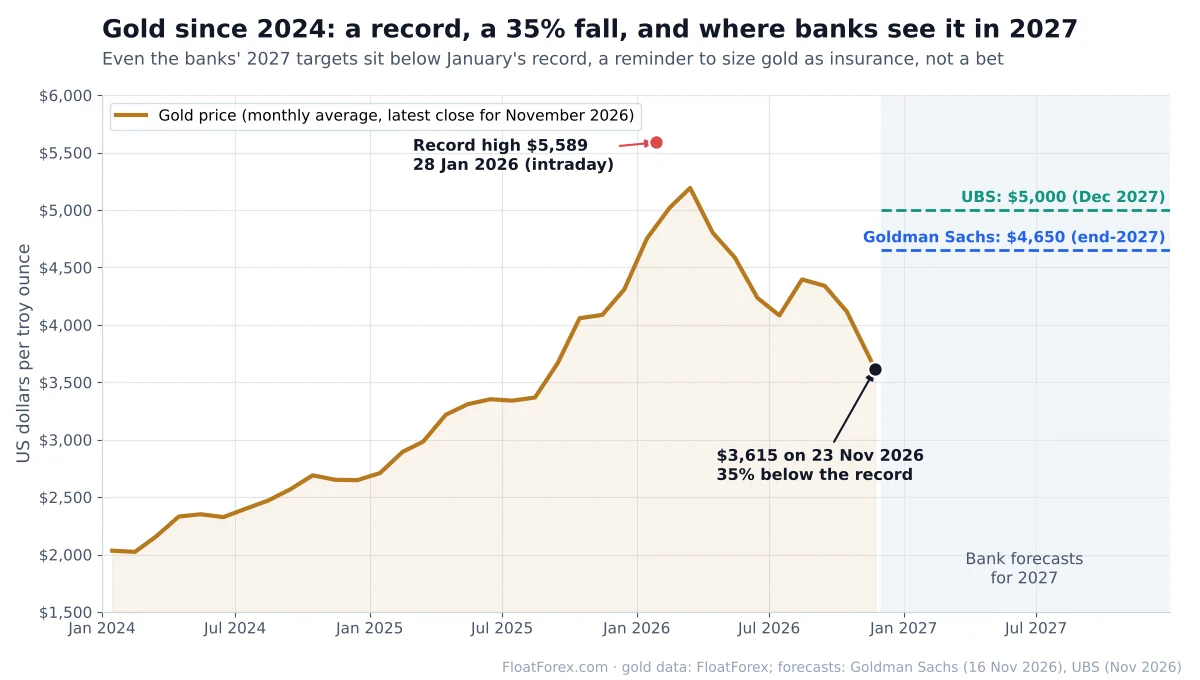
The fall has a clear cause. The Federal Reserve has turned hawkish, and Goldman Sachs expects rate hikes in December 2026 and March 2027. Higher rates make cash and bonds more attractive than a metal that pays nothing. Goldman's analysts, led by Lina Thomas, cut their end-2027 target to $4,650 and pushed their call for a new record out to the end of 2028, at $5,600. Their downside scenarios are $4,585 if the Fed hikes four times, and $4,265 if 300 tonnes of ETF gold is sold.
The support comes from central banks. Goldman assumes they keep buying about 60 tonnes a month through 2028, against a pre-2022 average of 17 tonnes. The bank's view is blunt: "We view this as a structural shift in reserve management behavior, and we do not expect a near-term reversal" (Kitco News). For a longer view on what drives gold, see our gold price forecast.
4. How a 35% Fall Affected Portfolios with Different Gold Weightings
This table shows why sizing matters more than timing. It assumes a $10,000 portfolio and shows only the change in the gold part, with everything else held constant:
| Gold allocation | Gold falls 35% (record to Nov 2026) | Gold falls another 15% | Gold rises 29% to Goldman's $4,650 | Gold rises 38% to UBS's $5,000 |
|---|---|---|---|---|
| 0% | $0 | $0 | $0 | $0 |
| 5% ($500) | −$177 (−1.8% of portfolio) | −$75 (−0.8%) | +$143 (+1.4%) | +$192 (+1.9%) |
| 10% ($1,000) | −$353 (−3.5%) | −$150 (−1.5%) | +$286 (+2.9%) | +$383 (+3.8%) |
| 15% ($1,500) | −$530 (−5.3%) | −$225 (−2.2%) | +$429 (+4.3%) | +$575 (+5.7%) |
| 20% ($2,000) | −$706 (−7.1%) | −$300 (−3.0%) | +$573 (+5.7%) | +$766 (+7.7%) |
An investor with 10% in gold who bought at the January peak has lost about 3.5% of their total portfolio, which is unpleasant but survivable. An investor who went "all in" lost 35%. That's the whole argument for treating gold as insurance, not a bet. 🛡️
5. Gold's Past Bear Markets: How Deep and How Long
Gold has fallen hard before. Based on monthly average prices:
| Fall | Peak | Low | Decline | Back to the old peak |
|---|---|---|---|---|
| 1980–1999 | $675 (Jan 1980) | $256 (Jul 1999) | −62% | May 2006, 26 years after the peak |
| 2008 financial crisis | $968 (Mar 2008) | $761 (Nov 2008) | −21% | Sep 2009, 18 months after the peak |
| 2011–2015 | $1,772 (Sep 2011) | $1,076 (Dec 2015) | −39% | Jul 2020, about 9 years after the peak |
| 2020–2022 | $1,969 (Aug 2020) | $1,664 (Oct 2022) | −15% | Apr 2023, about 2.7 years after the peak |
| 2026 | $5,589 (Jan 2026, intraday) | $3,539 (21 Nov 2026 close) | −37% so far | Not yet; Goldman expects late 2028 |
Source: FloatForex gold price history (monthly averages; 2026 row uses the intraday record and daily closes).
Two lessons stand out. First, gold can stay below a previous peak for a decade or more, so nobody should hold gold money they might need soon. Second, the falls that followed the biggest rallies (1980 and 2011) were the deepest. Gold rose about 63% in 2025 alone, so a deep correction was always possible.
6. Is Now a Good Time to Buy Gold?
Nobody can identify the bottom in advance, and that includes the big banks. Goldman Sachs cut its gold forecast three times between September and November 2026 (Canadian Mining Report). Here's an honest summary of both sides:
| Reasons gold could rise in 2027 | Reasons gold could fall further |
|---|---|
| Central banks bought 675 tonnes in the first nine months of 2026, and China's purchases are accelerating | The Fed is expected to raise rates again in December 2026 and March 2027 |
| Gold is 35% cheaper than in January | Higher interest rates raise the cost of holding gold |
| Bank forecasts for end-2027 ($4,650 to $5,000) are 29–38% above today's price | The same banks have cut their forecasts repeatedly this year |
| Government debt and inflation worries haven't gone away | An unwinding of gold ETF holdings could push prices lower, to about $4,265 in Goldman's scenario |
The trend is still down. Gold trades below its 20, 50 and 100-day moving averages, as our guide to moving averages explains. That's why the smartest answer to "is now the time?" is usually: buy in stages, so the timing doesn't matter as much.
7. How to Build Your Gold Allocation for 2027: Step by Step
- Pick a target that fits you. Use the table below as a starting point.
- Count the gold you already own. Jewellery, coins and bars all count. Many families in the Gulf, India and Pakistan already hold a meaningful share of their savings in gold jewellery. Value yours with today's Dubai, Saudi, India or Pakistan gold rates, or our price per gram by karat guide.
- Buy the rest in stages. Spread purchases over 6 to 12 months instead of investing everything at once.
- Choose low-cost exposure. See "Ways to hold gold" below.
- Rebalance once a year. Bring gold back to your target when it drifts more than about 5 percentage points away.
| Investor profile | Typical gold range | Why |
|---|---|---|
| Young, long horizon, growth-focused | 2–5% | Shares do the heavy lifting; gold is a small shock absorber |
| Balanced (most investors) | 5–10% | The range most research supports for risk-adjusted returns |
| Cautious or near retirement | 7–12% | More protection against stock market and inflation shocks |
| Very worried about inflation or currency risk | 10–15% | Close to Dalio's 15%; accept bigger swings in the gold part |
| Above 15% | Specialist only | Morgan Stanley's 20% replaces bonds; the 2026 fall shows the cost of being wrong |
A staged plan in practice: say you have a $20,000 portfolio and a 10% target, so $2,000 in gold. Buy about $167 a month for 12 months. If gold falls another 10% after your first purchase, you can bring forward one month's amount. That's dollar-cost averaging: you automatically buy more ounces when the price is low and fewer when it's high, and you never have to guess the bottom. 📅
8. Rebalancing: The Rule That Protects You at Both Ends
Rebalancing means selling a little of what has risen and buying a little of what has fallen to get back to your target. It sounds simple, but it forces you to do the hard thing: take profits near the top and add near the bottom.
Gold in 2025 showed why. Gold rose about 63%. If you started the year with 10% in gold and everything else stayed flat, gold would have grown to about 15% of your portfolio. Jeffrey Gundlach did exactly this in late 2025. He told CNBC that "if you had 25% gold it probably turned into 35% of your portfolio — it was time to rebalance back down," and cut his own gold weighting to about 10% (ThinkAdvisor). Investors who followed that rule sold some gold above $4,000 and now have cash to rebuild at about $3,600.
The rule now works the other way. If your gold has fallen from 10% to 7% of your portfolio, rebalancing tells you to top it up. 🔄
9. Ways to Hold Gold and What They Cost
| Method | Typical cost | Best for | Watch out for |
|---|---|---|---|
| Physical gold ETFs (e.g. GLDM, SGOL, IAU) | 0.10–0.25% a year | Most investors; easy to buy, sell and rebalance | Choose physically backed funds; compare fees on our gold charts page |
| Gold bars and coins | Dealer premium of a few percent, plus storage | Holding gold outside the financial system | Buying and selling spreads; safe storage and insurance |
| Gold jewellery | Making charges and VAT, often 10–25%+ | Wearing and gifting | Making charges and VAT are lost when you sell |
| Gold mining shares and ETFs | 0.35–0.40% a year for funds | Investors wanting higher risk and return | Miners often fall further than gold in a downturn |
| Leveraged gold ETFs | Around 0.95% a year | Short-term traders only | Losses are magnified; not for long-term allocation |
For a full comparison, read gold ETFs vs physical gold and our guide to what an ETF is. Buying in the Gulf? Our guide to buying gold in Saudi Arabia explains why 24K bars carry no VAT while jewellery carries 15%.
10. Common Gold Allocation Mistakes
- ❌ Going all in after a fall. Gold fell 39% from 2011 to 2015 and took nine years to recover. "Cheap" can get cheaper.
- ❌ Chasing the price after a rally. The investors hurt most in 2026 were those who bought heavily in January.
- ❌ Forgetting the gold you already own. Family jewellery is part of your allocation.
- ❌ Paying jewellery prices for investment gold. Making charges and VAT can cost more than a decade of ETF fees.
- ❌ Never rebalancing. Without a rule, a 10% allocation can quietly become 20% after a rally, and then fall 35%.
- ❌ Using money you'll need soon. Gold can stay below its peak for years.
Frequently Asked Questions
What percentage of my portfolio should be in gold?
Most research supports 5% to 10% for a typical investor. World Gold Council analysis found that 2.5% to 10% gold improved risk-adjusted returns over 20 years. Ray Dalio suggests about 15%, while Warren Buffett holds none. Your figure depends on your age, goals and how worried you are about inflation.
Is 10% gold in a portfolio too much?
No. 10% is at the upper end of the range most research supports, and close to the 7–10% many fund firms see among clients. At 10%, the 35% fall in gold from January to November 2026 cost a portfolio about 3.5% of its total value.
Is now a good time to buy gold in 2026 or 2027?
Gold is about 35% below its January 2026 record, and banks such as Goldman Sachs ($4,650) and UBS ($5,000) expect it to be higher by the end of 2027. But the Fed is still expected to raise rates, so prices could fall further first. Buying in stages over 6 to 12 months reduces the risk of bad timing.
What is the 60/20/20 portfolio?
The 60/20/20 portfolio holds 60% shares, 20% bonds and 20% gold. Morgan Stanley CIO Mike Wilson proposed it in September 2025 as an alternative to the classic 60/40, arguing that gold had become a better hedge than long-term bonds.
How much gold does Ray Dalio recommend?
Ray Dalio, founder of Bridgewater Associates, said in October 2025 that a strategic portfolio would probably hold about 15% in gold, because it tends to do well when the rest of a portfolio falls.
Does gold jewellery count as part of my gold allocation?
Yes, at its melt value rather than the price you paid. When you sell jewellery, you usually receive close to the value of the gold it contains, minus the shop's margin. Making charges and VAT aren't returned.
Should I buy physical gold or a gold ETF?
For most investors, a low-cost physically backed gold ETF is the simplest way to hold and rebalance gold, with annual fees from about 0.10%. Physical bars and coins suit people who want gold outside the financial system and can store it safely.
How often should I rebalance my gold allocation?
Once a year is enough for most investors, or whenever gold drifts more than about 5 percentage points from your target. In 2025, rebalancing meant selling some gold after its 63% rise; after the 2026 fall, it means topping it up.
Conclusion: The Right Amount Is the Amount You Can Hold Through a 35% Fall
The gold price has changed a lot in 2026. The rules for holding it haven't. For most investors, 5–10% is enough to improve a portfolio's stability without making it a bet on one metal; up to 15% is reasonable if inflation and currency risk worry you. Today's lower price makes building that position cheaper than it was in January, but no one knows if the bottom is in. So buy in stages, count the gold you already own, use low-cost ETFs or bars, and rebalance every year. Then, whatever gold does in 2027, you'll be glad you own some and relieved you don't own too much. 🪙
Keep tracking the market on our live gold price charts, and read how to protect your money from inflation for the bigger picture.
Sources
- World Gold Council: Gold as a Strategic Asset, 2026 edition (portfolio impact)
- World Gold Council: Gold Demand Trends Q3 2026, Central Banks
- World Gold Council / Oxford Economics: Higher allocations to gold could benefit portfolios
- Kitco News: Goldman Sachs sees gold reclaiming $5,600 in 2028 (17 Nov 2026)
- Fortune: Ray Dalio on a 15% gold allocation (Oct 2025)
- Reuters via Kitco: Morgan Stanley CIO favors 60/20/20 portfolio (Sep 2025)
- Fortune: Jamie Dimon on holding gold (Oct 2025)
- ThinkAdvisor: Gundlach slashes DoubleLine's gold holdings (Nov 2025)
- Warren Buffett in Fortune: Why stocks beat gold and bonds (2012)
- Alan Greenspan, "Golden Rule: Why Beijing Is Buying", Foreign Affairs, September 2014
- FloatForex gold price data (monthly history from 1950; daily prices to 23 November 2026)
This article is for education only and is not personal financial advice. The allocation ranges are general examples, not recommendations for your situation; consider speaking to a licensed financial adviser. Forecasts are the published views of the banks named and can change.